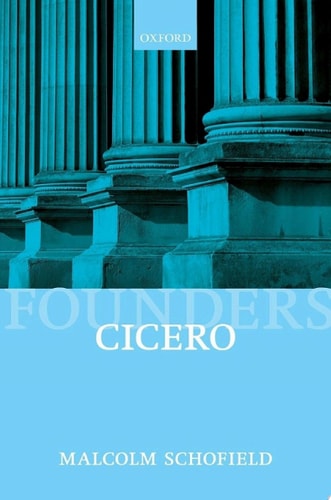
Cicero: Political Philosophy
0
0
As an Amazon Associate and affiliate partner, Menrva Books earns from qualifying purchases. Learn more
Author Description
This book offers an innovative analytic account of Cicero's treatment of key political ideas: liberty and equality, government, law, cosmopolitanism and imperialism, republican virtues, and ethical decision-making in politics. Cicero (106-43 BC) is well known as a major player in the turbulent politics of the last three decades of the Roman Republic. But he was a political thinker, too, influential for many centuries in the Western intellectual and cultural tradition. His theoretical writings stand as the first surviving attempt to articulate a philosophical rationale for republicanism. They were not written in isolation either from the stances he took in his political actions and political oratory of the period, or from his discussions of immediate political issues or questions of character or behaviour in his voluminous correspondence with friends and acquaintances. In this book, Malcolm Schofield situates the intimate interrelationships between Cicero's writings in all these modes within the historical context of a fracturing Roman political order. It exhibits the continuing attractions of Cicero's scheme of republican values, as well as some of its limitations as a response to the crisis that was engulfing Rome.
Menrva's Summary
THE THESIS
This book investigates the philosophical foundations of Cicero's political thought and his attempt to provide a rationale for republicanism within the context of the Roman Republic's collapse. Malcolm Schofield, a scholar of ancient philosophy, utilizes Cicero's theoretical treatises, oratory, and personal correspondence to construct an analytical framework. He argues that Cicero's political ideas were not abstract concepts but were deeply intertwined with his practical political actions and the specific crises facing the Roman state during the first century BC.
THE SCOPE MAP
What You Will Find
- Analysis of key concepts including liberty, equality, government, law, and cosmopolitanism
- Examination of the relationship between Cicero's philosophical writings and his political oratory
- Contextualization of republican virtues within the fracturing Roman political order
Scope Limits
- The book does not provide a comprehensive biography of Cicero's life outside of his political and philosophical contributions
- It does not offer an exhaustive history of the Roman Republic beyond the scope of Cicero's direct involvement
THE AUTHORITY PERSPECTIVE
Scholars recognize this work as a significant contribution to the study of Roman political thought, particularly for its integration of Cicero's correspondence with his formal philosophical output. Readers frequently note the academic density of the prose, which is well-suited for students and researchers of classical political theory.
Page Count:
299
Publication Date:
2020-01-01
Publisher:
OUP Oxford
ISBN-10:
0192637916
ISBN-13:
9780192637918
History
Philosophy
Ancient - Rome
Political Philosophy
Italy history
History & Surveys
Community Tags
Similar Books