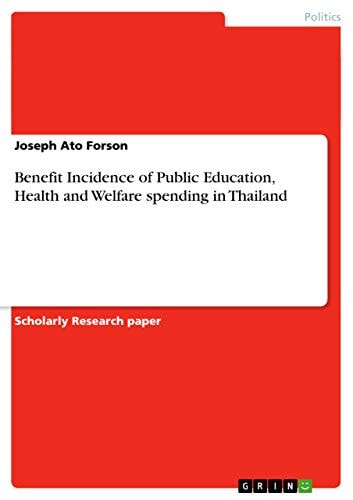
Benefit Incidence of Public Education, Health and Welfare Spending in Thailand
0
0
As an Amazon Associate and affiliate partner, Menrva Books earns from qualifying purchases. Learn more
Author Description
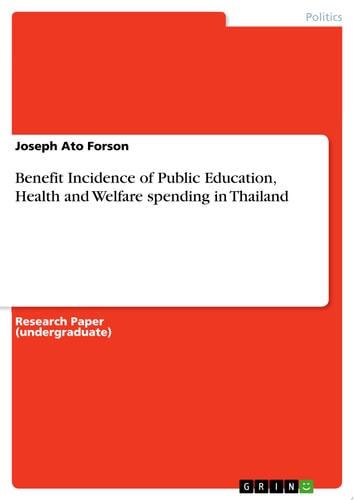
Research Paper (undergraduate) from the year 2013 in the subject Politics - International Politics - Region: South Asia, National Institute of Development Administration, course: Fiscal and Monetary Policy Analysis and Management, language: English, abstract: In this paper, there is an attempt to compile evidence on the benefit incidence of public education and health spending in 2005 in Thailand. The 2005 data marks an improvement over Medhi Krongkaew's 1979 analysis due to changes in the creation of the quintile income groups and marked improvement in the data collected on the whole. This paper is used to ascertain which income groups tend to benefit more from social spending. The paper also explores the relationship between benefit incidence on the one hand and indicators of access to education and health services and social outcomes on the other using simple measures of association. In addition, the paper explores the policy implications of these findings. In general, there is an attempt to enhance the position of the poor as the total (all) post-expenditure saw a major improvement in the Gini coefficient to record 0.2818 from 0.3056 or a rate of improvement of 2.38%. On the basis of these findings, it could be concluded that government's interventions or subsidies on the two functional areas is pro-poor or progressive as it seeks to favor the poor. This will enhance the position of the poor as to accessing these two facilities in Thailand. We make a number of policy recommendations to enhance government's efforts in eradicating poverty in the not distant future.
Menrva's Summary
THE THESIS
This paper investigates the distribution of benefits from public spending on education, health, and welfare in Thailand during 2005. The research aims to determine which income groups disproportionately benefit from these social expenditures, building upon previous analyses with improved data and income group classifications. It further explores the correlation between benefit incidence and access to services, as well as social outcomes, using simple association measures. The study concludes that government interventions in education and health are progressive, favoring the poor and improving the Gini coefficient, and offers policy recommendations to further poverty eradication efforts.
THE SCOPE MAP
- Analysis of benefit incidence for public education and health spending in Thailand in 2005.
- Comparison with previous analyses, noting improvements in data and income group creation.
- Examination of which income groups benefit most from social spending.
- Exploration of the relationship between benefit incidence and access to education and health services.
- Investigation of the link between benefit incidence and social outcomes.
- Assessment of the impact of post-expenditure Gini coefficient changes.
- Discussion of policy implications for poverty reduction.
- Policy recommendations to enhance government efforts in poverty eradication.
THE AUTHORITY PERSPECTIVE
The study provides a detailed analysis of public spending benefits in Thailand, utilizing improved data from 2005 to assess the progressivity of education and health expenditures. It highlights a positive impact on the Gini coefficient, suggesting that current interventions are indeed pro-poor. The research offers valuable insights into the distribution of social welfare and proposes policy recommendations aimed at further poverty alleviation. The work is grounded in empirical data and analytical methods, contributing to the understanding of fiscal policy's role in social equity.
Page Count:
28
Publication Date:
2013-05-01
Publisher:
GRIN Verlag
ISBN-10:
3656422176
ISBN-13:
9783656422174
Non-Fiction
Economics
Public Policy
Education Policy
Social Welfare
Health Economics