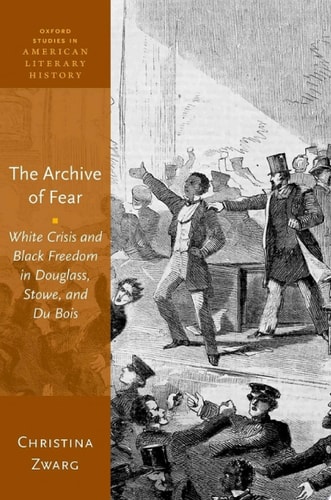
The Archive of Fear: White Crisis and Black Freedom in Douglass, Stowe, and Du Bois
0
0
As an Amazon Associate and affiliate partner, Menrva Books earns from qualifying purchases. Learn more
Author Description
Focusing on U.S. slavery and its aftermath in the nineteenth century, The Archive of Fear explores the traumatic force field that continued to inflect discussions of slavery and abolition both before and after the Civil War. It challenges the long-assumed distinction between psychological and cultural-historical theories of trauma, discovering a virtual dialogue between three central U. S. writers and Sigmund Freud concerning the traumatic response of slavery's perpetrators. A strain of trauma theory and practice comes alive in the temporal and spatial disruptions of New World slavery-and The Archive of Fear shows how key elements of that theory still inform the infrastructure of race relations today. It argues that trauma theory before Freud first involves a return to an overlap between crisis, insurrection, and mesmerism found in the work of Frederick Douglass, Harriet Beecher Stowe, and W. E. B. Du Bois. Mesmer's "crisis state" has long been read as the precursor to hypnosis, the tool Freud famously rejected when he created psychoanalysis. But the story of what was lost to trauma theory when Freud adopted the "talk cure" can be told through cultural disruptions of New World slavery, especially after mesmerism arrived in Saint Domingue where its implication in the Haitian revolution in both reality and fantasy had an impact on the history of emancipation in the United States.
Menrva's Summary
THE THESIS
This work investigates how the traumatic legacy of U.S. slavery and its aftermath shaped nineteenth-century cultural discourse and continues to influence contemporary race relations. Christina Zwarg, an expert in American literary history, utilizes a comparative framework to examine the writings of Frederick Douglass, Harriet Beecher Stowe, and W. E. B. Du Bois. By integrating these literary perspectives with the history of mesmerism and early trauma theory, the author argues that the "crisis state" associated with slavery’s perpetrators provides a critical, often overlooked, precursor to modern psychoanalytic understandings of trauma.
THE SCOPE MAP
What You Will Find
- Analysis of the intersection between nineteenth-century American literature and the history of mesmerism.
- Examination of the Haitian Revolution's impact on U.S. emancipation discourse.
- Comparative study of Frederick Douglass, Harriet Beecher Stowe, and W. E. B. Du Bois.
- Theoretical exploration of the "crisis state" as a mechanism for understanding historical trauma.
Scope Limits
- The text does not provide a comprehensive history of the abolitionist movement.
- It does not offer a clinical manual for modern psychological trauma treatment.
THE AUTHORITY PERSPECTIVE
Scholars recognize this text as a sophisticated intervention in the field of American literary history that bridges the gap between cultural studies and psychoanalytic theory. Readers frequently note the academic density of the prose, which requires a strong background in literary criticism and historical theory to fully appreciate the author's complex arguments.
Page Count:
208
Publication Date:
2020-01-01
Publisher:
OUP Oxford
ISBN-10:
0192636073
ISBN-13:
9780192636072
Literary Criticism
African American
Trauma Theory
History of Psychology
American History
Community Tags
Similar Books