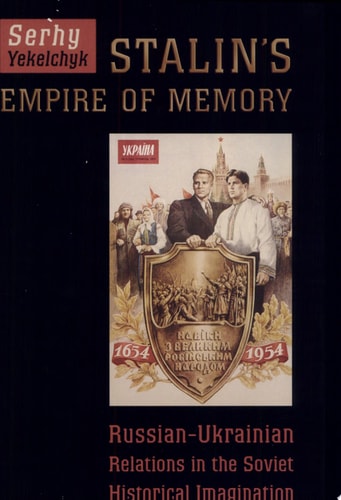
Stalin's Empire of Memory: Russian-Ukrainian Relations in the Soviet Historical Imagination
0
0
As an Amazon Associate and affiliate partner, Menrva Books earns from qualifying purchases. Learn more
Author Description
Based on declassified materials from eight Ukrainian and Russian archives, Stalin's Empire of Memory, offers a complex and vivid analysis of the politics of memory under Stalinism. Using the Ukrainian republic as a case study, Serhy Yekelchyk elucidates the intricate interaction between the Kremlin, non-Russian intellectuals, and their audiences. Yekelchyk posits that contemporary representations of the past reflected the USSR's evolution into an empire with a complex hierarchy among its nations. In reality, he argues, the authorities never quite managed to control popular historical imagination or fully reconcile Russia's 'glorious past' with national mythologies of the non-Russian nationalities. Combining archival research with an innovative methodology that links scholarly and political texts with the literary works and artistic images, Stalin's Empire of Memory presents a lucid, readable text that will become a must-have for students, academics, and anyone interested in Russian history.
Menrva's Summary
THE THESIS
This book investigates the complex interplay between historical memory and Soviet imperial policy, using the Ukrainian SSR as a primary case study. Serhy Yekelchyk analyzes how the Kremlin, non-Russian intellectuals, and their audiences negotiated representations of the past to reflect the USSR's evolving imperial structure. The work argues that while authorities attempted to shape historical narratives to fit a hierarchy of nations, they ultimately failed to fully control popular historical imagination or reconcile Russia's dominant historical narrative with those of the non-Russian republics. The book combines extensive archival research with an innovative methodology that bridges scholarly and political texts with literary and artistic works.
THE SCOPE MAP
- Analysis of declassified materials from eight Ukrainian and Russian archives.
- Case study focusing on the Ukrainian Republic's experience within the Soviet system.
- Examination of the interaction between the Kremlin, non-Russian intellectuals, and audiences.
- Exploration of how representations of the past reflected the USSR's imperial evolution and national hierarchies.
- Argument that authorities could not fully control popular historical imagination.
- Methodology linking scholarly and political texts with literary works and artistic images.
- Focus on the politics of memory under Stalinism.
THE AUTHORITY PERSPECTIVE
The book is recognized for its complex and vivid analysis of the politics of memory under Stalinism, utilizing declassified archival materials to illuminate the intricate relationship between the Kremlin and non-Russian intellectuals. Its innovative methodology, which integrates scholarly texts with literary and artistic representations, offers a lucid and readable account of Soviet historical imagination. The work is considered essential for students, academics, and anyone interested in Russian and Ukrainian history, particularly concerning the USSR's imperial dynamics and the challenges of controlling national narratives. It provides a nuanced perspective on how historical memory functioned within the Soviet empire.
Page Count:
231
Publication Date:
2004-01-01
Publisher:
University of Toronto Press
ISBN-10:
0802088082
ISBN-13:
9780802088086
Non-Fiction
History
Imperialism
Soviet Union
Memory Studies
Russian History
Community Tags
Similar Books