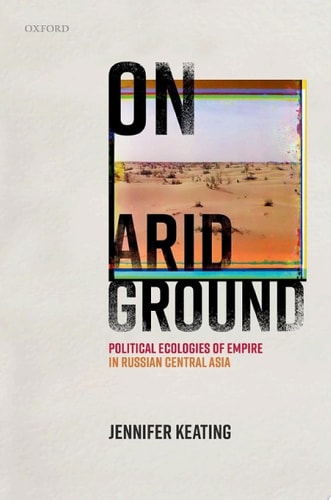
On Arid Ground: Political Ecologies of Empire in Russian Central Asia
0
0
As an Amazon Associate and affiliate partner, Menrva Books earns from qualifying purchases. Learn more
Author Description
On Arid Ground focuses on the relationships between empire and environment in Central Asia, using environmental history to examine the practice of Russian imperialism in Turkestan at the end of empire, from the 1860s until 1916. It reveals for the first time a comprehensive assessment of the environmental imprint of Russian colonisation, and shows how local ecologies fitted into broader repertoires of imperial rule, accommodation, and resistance. Ranging widely above and below the surface in Turkestan, from the deserts of Transcaspia to the highlands and lowlands of rural Fergana and Semirech'e, Jennifer Keating explores infrastructure development, migrant settlement, land reclamation and dispossession, the commodification of nature, and environmental violence to reveal the ways in which ecological change was central to the building and breaking of empire. Attentive to connections, synchronicities and scale, On Arid Ground makes the case for looking beyond cotton and water in Central Asian context, for the powerful material role played by animals and plants, sand, silt, and salt in human histories, and for the less visible relationships between far-flung people and things within and beyond Turkestan's borders. Laying bare the political roots and repercussions of environmental change, the volume brings fresh perspectives both to the history of Central Asia and to that of the wider Russian empire across Eurasia.
Menrva's Summary
THE THESIS
This work investigates how environmental transformation served as a fundamental mechanism for the establishment and eventual collapse of Russian imperial rule in Turkestan between 1860 and 1916. Jennifer Keating, a historian specializing in the Russian Empire, utilizes archival research and environmental history methodologies to argue that ecological change—ranging from land reclamation to the commodification of natural resources—was not merely a byproduct of colonization but a central instrument of imperial power and local resistance.
THE SCOPE MAP
What You Will Find
- Analysis of infrastructure development, migrant settlement, and land dispossession in Turkestan.
- Examination of the material roles of animals, plants, sand, silt, and salt in imperial expansion.
- Case studies covering the deserts of Transcaspia and the rural regions of Fergana and Semirech'e.
Scope Limits
- The study focuses specifically on the period from the 1860s to 1916 and does not extend into the Soviet era.
- The analysis is geographically constrained to the Russian imperial administration of Turkestan.
THE AUTHORITY PERSPECTIVE
Scholars in the field of Eurasian history recognize this text as a significant contribution to the study of imperial environmental policy. Readers frequently note the academic density of the prose and the author's success in integrating ecological factors into traditional political narratives.
Page Count:
266
Publication Date:
2022-01-01
Publisher:
OUP Oxford
ISBN-10:
0192667505
ISBN-13:
9780192667502
History
Asia history
Russian History
Colonialism
Imperialism
Asian History
Environmental History
Community Tags
Similar Books