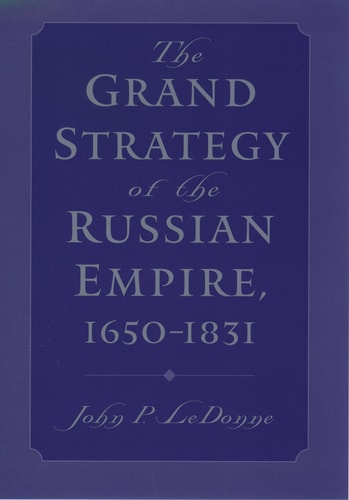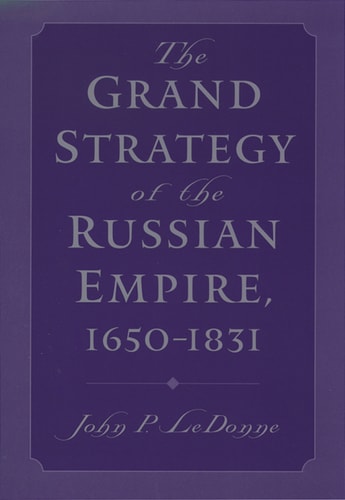
The Grand Strategy of the Russian Empire, 1650-1831
0
0
As an Amazon Associate and affiliate partner, Menrva Books earns from qualifying purchases. Learn more
Author Description
At its height, the Russian empire covered eleven time zones and stretched from Scandinavia to the Pacific Ocean. Arguing against the traditional historical view that Russia, surrounded and threatened by enemies, was always on the defensive, John P. LeDonne contends that Russia developed a long-term strategy not in response to immediate threats but in line with its own expansionist urges to control the Eurasian Heartland. LeDonne narrates how the government from Moscow and Petersburg expanded the empire by deploying its army as well as by extending its patronage to frontier societies in return for their serving the interests of the empire. He considers three theaters on which the Russians expanded: the Western (Baltic, Germany, Poland); the Southern (Ottoman and Persian Empires); and the Eastern (China, Siberia, Central Asia). In his analysis of military power, he weighs the role of geography and locale, as well as economic issues, in the evolution of a larger imperial strategy. Rather than viewing Russia as peripheral to European Great Power politics, LeDonne makes a powerful case for Russia as an expansionist, militaristic, and authoritarian regime that challenged the great states and empires of its time.
Menrva's Summary
THE THESIS
John P. LeDonne investigates whether the expansion of the Russian Empire between 1650 and 1831 was a reactive defensive posture or a deliberate, long-term strategy of imperial growth. LeDonne, a scholar of Russian imperial history, challenges the conventional historiography that frames Russia as a perpetually threatened state. By analyzing administrative records and military deployments, he argues that the Russian government actively pursued a proactive strategy to dominate the Eurasian Heartland through both military force and the co-option of frontier societies.
THE SCOPE MAP
What You Will Find
- Analysis of Russian expansion across three primary theaters: Western, Southern, and Eastern.
- Examination of the integration of frontier societies into the imperial patronage system.
- Evaluation of the interplay between geography, economic constraints, and military power.
Scope Limits
- The analysis is strictly confined to the period between 1650 and 1831.
- The text focuses primarily on state-level strategic planning rather than the social history of the Russian peasantry.
THE AUTHORITY PERSPECTIVE
Historians and scholars of Russian studies frequently cite this work for its rigorous challenge to traditional defensive-state narratives. Readers often note the academic density of the prose, which requires a foundational understanding of 17th and 18th-century European and Asian geopolitics.
Page Count:
261
Publication Date:
2003-01-01
Publisher:
Oxford University Press
ISBN-10:
0190289686
ISBN-13:
9780190289683
History
Eastern Europe
Geopolitics
European History
Russian History
Military History
Imperialism