Author Description
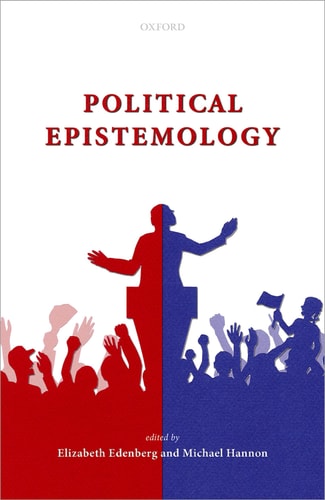
This collection explores one of the most rapidly growing area of philosophy: political epistemology. Epistemological issues are at the center of our political lives. It has become increasingly difficult to discern legitimate sources of evidence, misinformation spreads faster than ever, and the role of truth in politics has allegedly decayed in recent years. It is therefore no coincidence that political discourse is currently saturated with epistemic notions like “post-truth,” “fake news,” “truth decay,” “echo chambers,” and “alternative facts.” Political Epistemology brings together leading philosophers to explore ways in which the analytic and conceptual tools of epistemology bear on political philosophy, and vice versa. It is organized around three broad themes: truth and knowledge in politics; epistemic problems for democracy; and disagreement and polarization. The contributors provide new and rich insights on topics such as: propaganda, fake news, weaponized skepticism, belief polarization, political disagreement, the epistemic value of democracy, voter ignorance, irrationality in politics, and identity politics. A premise underlying the development of political epistemology is that progress on certain foundational issues in both political philosophy and epistemology cannot be achieved without sharing insights across fields, beyond a certain point. This will be a foundational text for philosophers, political scientists, and political psychologists for years to come.
Menrva's Summary
THE THESIS
This collection investigates the intersection of political philosophy and epistemology to address how truth, evidence, and knowledge function within contemporary political discourse. The contributors, a group of leading philosophers, utilize analytic and conceptual frameworks to examine the erosion of shared reality in public life. By bridging the gap between political theory and epistemological inquiry, the text argues that foundational progress in both fields requires a collaborative, interdisciplinary approach to modern challenges like misinformation and polarization.
THE SCOPE MAP
What You Will Find
- Analysis of epistemic concepts including post-truth, fake news, and echo chambers
- Theoretical frameworks for evaluating the epistemic value of democratic systems
- Investigations into the mechanics of belief polarization and weaponized skepticism
- Discussions on voter ignorance and the role of identity politics in shaping belief
Scope Limits
- The text focuses primarily on analytic philosophical perspectives rather than empirical political science data
- It does not provide practical policy solutions for mitigating misinformation
THE AUTHORITY PERSPECTIVE
Experts identify this collection as a foundational resource for scholars working at the intersection of political science and philosophy. Readers frequently note the academic density of the prose, which is tailored specifically for researchers and advanced students in the field.
Page Count:
337
Publication Date:
2021-01-01
Publisher:
OUP Oxford
ISBN-10:
0192645382
ISBN-13:
9780192645388
Philosophy
Epistemology
Political Philosophy
Community Tags
Similar Books