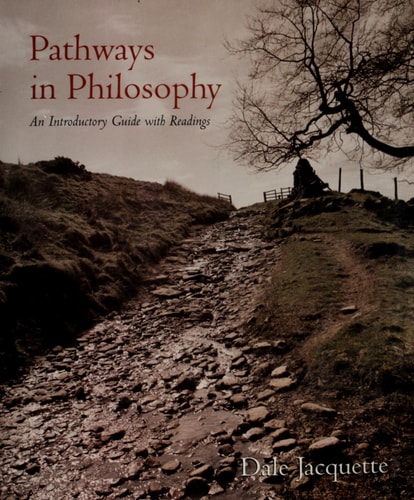
Pathways in Philosophy: An Introductory Guide with Readings
0
0
As an Amazon Associate and affiliate partner, Menrva Books earns from qualifying purchases. Learn more
Author Description
Pathways in Philosophy is a unique introductory text that features both a historical and a topical approach to the central problems in the field--questions regarding existence, knowledge, and moral and political value. Organized into two parts, "Metaphysics and Epistemology" and "Ethics and Political Philosophy," the text addresses these problems by providing a guided tour through ten classic philosophical readings. Offering detailed critical commentary, Jacquette carefully explains and analyzes seminal works by Plato, Aristotle, Ockham, Descartes, Berkeley, Kant, Mill, Nietzsche, Moore, and Rawls. He applies the "pathways" metaphor to the various intersecting and overlapping lines of thought represented by this selection of authors, drawing surprising connections between their ideas. This approach enables students to appreciate the relationships between what may otherwise appear to be disparate strands of thought in great works of philosophy and in different traditions of philosophical thought. By following the historical and philosophical narrative in each chapter, students learn how to interpret and critically evaluate difficult philosophical writings in their historical contexts--how to identify concepts, questions, definitions, arguments, and major components of philosophical reasoning in a systematic way.Offering a combination of historical coverage and rigorous critical evaluation, Pathways in Philosophy is ideal for courses in introductory philosophy. The text is enhanced by study questions, key terms, and suggested readings at the end of each chapter, as well as a glossary at the end of the book.
Menrva's Summary
THE THESIS
This text investigates how to bridge the gap between historical philosophical traditions and contemporary analytical inquiry through a structured, guided reading of seminal works. Dale Jacquette, a professor of philosophy, utilizes his expertise to synthesize complex arguments from ten major thinkers, providing a framework that allows students to navigate the intersections of metaphysics, epistemology, ethics, and political theory. By organizing the material into two distinct parts, the author demonstrates how disparate philosophical ideas form coherent, overlapping pathways of thought.
THE SCOPE MAP
What You Will Find
- A dual-approach methodology combining historical context with topical thematic analysis.
- Detailed critical commentary on foundational texts by Plato, Aristotle, Ockham, Descartes, Berkeley, Kant, Mill, Nietzsche, Moore, and Rawls.
- Pedagogical tools including chapter-specific study questions, key term definitions, and annotated suggested readings.
- A comprehensive glossary designed to assist students in mastering technical philosophical vocabulary.
THE AUTHORITY PERSPECTIVE
Instructors frequently utilize this text as a foundational resource for undergraduate introductory courses due to its clear integration of primary source readings and critical analysis. Experts note that the book effectively balances academic rigor with accessibility, making it a standard tool for teaching students how to systematically evaluate philosophical arguments.
Page Count:
574
Publication Date:
2003-09-18
Publisher:
Oxford University Press
ISBN-10:
0195131312
ISBN-13:
9780195131314
Philosophy
Metaphysics
Philosophy
Epistemology
Education
Ethics
Political Philosophy
Community Tags
Similar Books