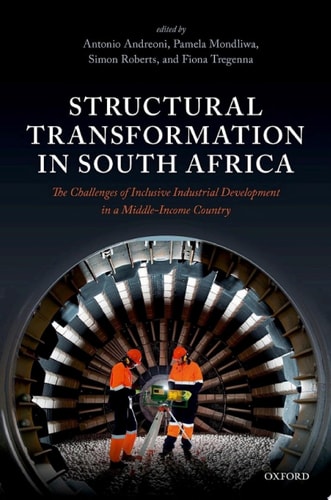
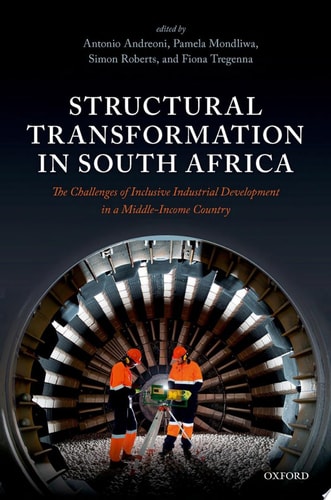
Structural Transformation in South Africa: The Challenges of Inclusive Industrial Development in a Middle-Income Country
0
0
As an Amazon Associate and affiliate partner, Menrva Books earns from qualifying purchases. Learn more
Author Description
Taking South Africa as an important case study of the challenges of structural transformation, Structural Transformation in South Africa offers a new micro-meso level framework and evidence linking country-specific and global dynamics of change, with a focus on the current challenges and opportunities faced by middle-income countries. Detailed analyses of industry groupings and interests in South Africa reveal the complex set of interlocking country-specific factors which have hampered structural transformation over several decades, but also the emerging productive areas and opportunities for structural change. The structural transformation trajectory of South Africa presents a unique country case, given its industrial structure, concentration and highly internationalized economy, as well as the objective of black economic empowerment. Structural Transformation in South Africa links these micro-meso dynamics to global forces driving economic, institutional and social change. This include digital industrialization, global value chain consolidation, financialization, environmental and other sustainability challenges, which are reshaping structural transformation dynamics across middle-income countries like South Africa. While these new drivers of change are disrupting existing industries and interests in some areas, in others they are reinforcing existing trends and configurations of power. The book analyses the ways in which both the domestic and global drivers of structural transformation shape-and, in some cases, are shaped by-a country's political settlement and its evolution. By focusing on the political economy of structural transformation, the book disentangles the specific dynamics underlying the South African experience of the middle-income country conundrum. In so doing, it brings to light the broader challenges faced by similar countries in achieving structural transformation via industrial policies.
Menrva's Summary
THE THESIS
This book investigates the specific barriers and opportunities for structural transformation in South Africa, questioning how a middle-income country can achieve inclusive industrial development amidst complex domestic and global pressures. Authors Shawna Longo and Zachary Gates utilize a micro-meso level framework to analyze the intersection of South Africa's unique industrial concentration, its highly internationalized economy, and the mandate for black economic empowerment. By examining the political economy of these sectors, the authors argue that domestic political settlements and global forces—such as financialization and digital industrialization—collectively dictate the trajectory of industrial change.
THE SCOPE MAP
What You Will Find
- Analysis of industry groupings and interest configurations within the South African economy.
- A micro-meso level framework for evaluating structural transformation in middle-income nations.
- Examination of global drivers including digital industrialization, global value chain consolidation, and environmental sustainability.
- Discussion of the political economy surrounding black economic empowerment and institutional change.
Scope Limits
- The text does not provide a comprehensive history of South African macroeconomic policy prior to the post-apartheid era.
- It does not offer prescriptive policy solutions for other middle-income countries outside of the South African context.
THE AUTHORITY PERSPECTIVE
Experts view this work as a rigorous contribution to development economics, specifically regarding the 'middle-income country conundrum.' Readers frequently note the academic density of the prose, which is tailored for researchers and policymakers focused on industrial policy and political economy.
Page Count:
410
Publication Date:
2021-01-01
Publisher:
OUP Oxford
ISBN-10:
0192646761
ISBN-13:
9780192646767
Economics
International Trade
African history
Industrial Policy
Community Tags
Similar Books


Reader Comments
Share Your Thoughts
No comments yet. Be the first to share your thoughts!