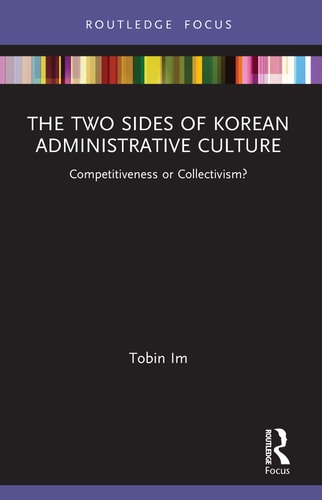
The Two Sides of Korean Administrative Culture: Competitiveness Or Collectivism?
0
0
As an Amazon Associate and affiliate partner, Menrva Books earns from qualifying purchases. Learn more
Author Description
This book explores two contradictory aspects of the Korean culture: competitiveness and collectivism. These two major concepts describe the dynamics of Korean public organizations, which explain the Hangang River Economic Miracle and political democratization. However, not many studies have focused on how competition within the central government, that is, competition among different agencies, has led to an overall competitive government. This book attempts to do so and explains how competition contributed to the rapid economic growth of Korea.
Menrva's Summary
THE THESIS
This book investigates the paradoxical coexistence of competitiveness and collectivism within Korean public administration and its impact on national development. It examines how the dynamics of competition among central government agencies, often overlooked, have fueled Korea's rapid economic growth and political democratization, commonly referred to as the 'Hangang River Economic Miracle'. The author, Tobin Im, draws upon extensive research to explain this phenomenon, focusing on the specific mechanisms through which inter-agency competition has contributed to an overall competitive government structure.
THE SCOPE MAP
- Analysis of the 'Hangang River Economic Miracle' through the lens of administrative culture.
- Exploration of the dualistic nature of Korean administrative culture: competitiveness versus collectivism.
- Examination of inter-agency competition within the central government.
- Case studies illustrating how competition has driven economic growth and political democratization.
- Discussion of the theoretical frameworks explaining the interplay between cultural traits and public organizational dynamics.
- Insights into the specific policies and reforms that fostered a competitive administrative environment.
- Comparative analysis of Korean administrative culture with other East Asian nations (implied by context).
THE AUTHORITY PERSPECTIVE
The book offers a focused examination of a unique aspect of Korean administrative culture, providing a detailed analysis of how inter-agency competition has shaped the nation's economic and political landscape. The author's approach highlights a less-discussed driver of Korea's success, suggesting that a deeper understanding of these internal dynamics is crucial for comprehending its development trajectory. The work is likely to appeal to scholars and students of public administration, Korean studies, and comparative economic development.
Page Count:
120
Publication Date:
2021-06-30
Publisher:
Routledge
ISBN-10:
1032093137
ISBN-13:
9781032093130
History
Non-Fiction
Politics
Asian Studies
Economic History
Public Administration
Sociology
Community Tags
Similar Books