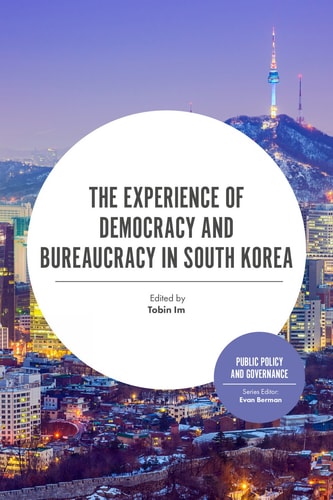
The Experience of Democracy and Bureaucracy in South Korea
0
0
As an Amazon Associate and affiliate partner, Menrva Books earns from qualifying purchases. Learn more
Author Description
South Korea is renowned as one of the success stories of fast economic development. The Korean developmental state was a highly efficient, meritocratic, and fully monopolized coercive force. These resources were skilfully leveraged to shape the direction of private sector actors towards strategic initiatives. However, these very same resources could have resulted in the bureaucracy retaining its power indefinitely. Instead, step-by-step, the resources of the bureaucracy, which serviced the authoritarian leadership in the developmental period, were exercised towards democratization. What were the conditions that made this transformation possible? The Experience of Democracy and Bureaucracy in South Korea addresses this question, filling the existing gap in the academic literature and presenting political implications. It explores the ways in which bureaucracy may not only be compatible with democracy but, more ambitiously, the conditions under which it can enhance it. The chapters examine the unique systems and institutions of the Korean bureaucracy including the National Election Commission, the police force, local government, the ceiling recruitment strategy, and procurement policy. This timely collection will be of interest to researchers, graduate and undergraduate students in public administration and policy. It will also be a useful reference for bureaucrats in developing countries who seek to design policy for bureaucracy in concurrence with democratization.
Menrva's Summary
THE THESIS
This book investigates the conditions under which a powerful bureaucracy, instrumental in South Korea's authoritarian developmental state, transitioned to support and enhance democracy. The authors explore how the resources and institutions that once served an authoritarian regime were strategically redirected towards democratization, a transformation that fills a significant gap in academic literature. The work examines specific Korean bureaucratic systems, including the National Election Commission, the police force, and local government, to understand this unique shift. It ultimately posits that bureaucracy can not only be compatible with democracy but can actively contribute to its strengthening.
THE SCOPE MAP
- Analysis of the Korean developmental state's bureaucratic efficiency and meritocracy.
- Exploration of how bureaucratic resources were leveraged to shape private sector initiatives.
- Examination of the conditions that facilitated the bureaucracy's transition from authoritarianism to democratization.
- Case studies of specific Korean bureaucratic systems: National Election Commission, police force, local government.
- Discussion of the ceiling recruitment strategy and procurement policy within the Korean context.
- Implications for public administration and policy design in developing countries undergoing democratization.
THE AUTHORITY PERSPECTIVE
The book is positioned as a timely collection of interest to researchers and students in public administration and policy, offering a unique perspective on the relationship between bureaucracy and democracy. It aims to fill an existing gap in academic literature by exploring how a bureaucracy can not only coexist with democracy but actively enhance it. The work is also intended as a useful reference for bureaucrats in developing nations seeking to align policy with democratization efforts. Its focus on the specific Korean experience provides a detailed case study for broader theoretical discussions.
Page Count:
206
Publication Date:
2017-10-12
Publisher:
Emerald Publishing Limited
ISBN-10:
1787149390
ISBN-13:
9781787149397
History
Non-Fiction
Politics
Public Administration
Bureaucracy
Asian Studies
Community Tags
Similar Books