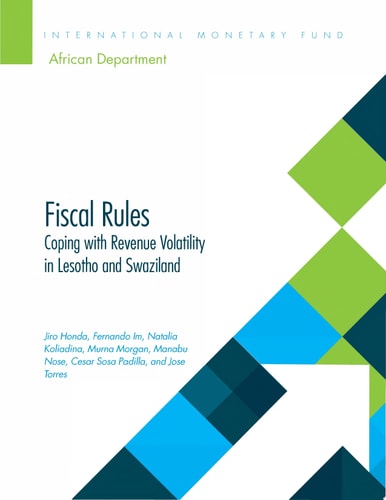
Fiscal Rules: Coping with Revenue Volatility in Lesotho and Swaziland
0
0
As an Amazon Associate and affiliate partner, Menrva Books earns from qualifying purchases. Learn more
Author Description
Over the past decade, Lesotho and Swaziland have faced significant volatility in their fiscal revenues, owing to highly unstable Southern African Customs Union (SACU) receipts. Based on model analysis, this paper explores the advantages of implementing fiscal rules to deal with such volatility. It finds that the use of a structural balance target could smooth the growth impact from revenue shocks while helping preserve sufficient international reserves during bad times. From a long-term perspective, it suggests possible welfare gains from introducing fiscal rules. Last, it concludes that, based on experiences in other countries, developing strong institutions and improving public financial management are necessary steps to ease the transitions to a rules-based fiscal policy framework.
Menrva's Summary
THE THESIS
This paper investigates the challenges posed by volatile fiscal revenues in Lesotho and Swaziland, primarily stemming from unstable Southern African Customs Union (SACU) receipts. The analysis explores the efficacy of fiscal rules in mitigating these revenue shocks, with a focus on how a structural balance target can smooth growth impacts and maintain international reserves during economic downturns. It further examines the potential long-term welfare benefits of adopting such rules and highlights the critical role of strong institutions and improved public financial management in facilitating this transition.
THE SCOPE MAP
- Analysis of fiscal revenue volatility in Lesotho and Swaziland over the past decade.
- Exploration of the advantages of implementing fiscal rules to manage revenue instability.
- Model analysis to assess the impact of a structural balance target on growth and reserves.
- Discussion of potential long-term welfare gains from fiscal rules.
- Identification of necessary steps for transitioning to a rules-based fiscal policy framework.
- Consideration of experiences from other countries in adopting fiscal rules.
- Emphasis on the importance of strong institutions and public financial management.
THE AUTHORITY PERSPECTIVE
This paper offers a technical analysis of fiscal policy challenges faced by Lesotho and Swaziland, focusing on the practical application of fiscal rules to manage revenue volatility. The research utilizes model analysis to support its findings regarding the benefits of structural balance targets for economic stability and reserve management. It concludes by emphasizing the institutional prerequisites for successful implementation of such policies, drawing on international comparisons. The work is positioned as a resource for policymakers and economists interested in fiscal management in developing economies.
Page Count:
53
Publication Date:
2017-09-12
Publisher:
International Monetary Fund
ISBN-10:
148430957X
ISBN-13:
9781484309575
Politics
Economics
Non-Fiction
Community Tags
Similar Books