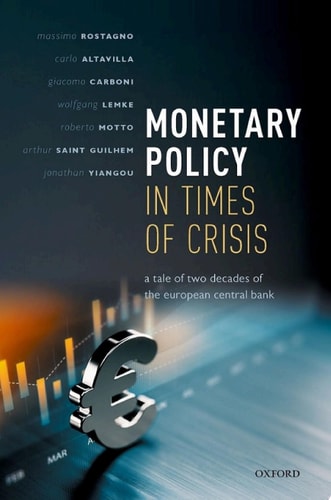
Monetary Policy in Times of Crisis: A Tale of Two Decades of the European Central Bank
0
0
As an Amazon Associate and affiliate partner, Menrva Books earns from qualifying purchases. Learn more
Author Description
The first twenty years of the European Central Bank (ECB) offer a clear demonstration of how a central bank can navigate macroeconomic insecurity and crisis. As the global economy moves into a new phase of unheralded uncertainty, the story of the ECB holds multiple lessons of wider significance for the central banking community and researchers of monetary policy. This volume provides a unique account of how the ECB has reacted to the challenges confronting the euro area through its monetary policy, turning to innovative measures and unprecedented policy actions to fend off the various threats posed by the global financial turmoil of 2007/08, the euro area sovereign debt market crisis, and the subsequent period of anaemic growth and deflationary pressures. It also addresses some of the criticisms the ECB has faced regarding its policy initiatives. It identifies the ultimate motivation behind the ECB's cautious attitude in the early phases of the financial crisis, and its peculiar definition of price stability and attention for credit creation, as well as addressing the criticism that central banks were fundamentally unprepared to head off a major financial cataclysm as they were wedded to a deficient economic paradigm which made them blind to financial risks. It also shows that the ECB's unconventional low-interest policies have not compromised the position of financial intermediaries in the way commentators initially predicted they would. By condensing the facts and lessons of the first 20 years of the ECB, this volume will acquaint the reader with the structures and decision-making processes behind the complex, often controversial, crisis measures that were taken during some of the toughest economic challenges in the history of modern Europe, and provide them with fresh ex-post analysis on their effect on the real economy and inflation.
Menrva's Summary
THE THESIS
This volume investigates how the European Central Bank (ECB) navigated two decades of macroeconomic instability, specifically addressing the question of how central banking institutions adapt to unprecedented financial crises. The authors, a team of economists and researchers associated with the ECB, utilize internal data and historical analysis to evaluate the efficacy of unconventional monetary policy measures implemented between 2007 and the present. They argue that the ECB's strategic evolution was a necessary response to systemic threats, providing a detailed defense against criticisms regarding their initial caution and subsequent policy shifts.
THE SCOPE MAP
What You Will Find
- Analysis of the 2007/08 global financial crisis and the euro area sovereign debt crisis.
- Evaluation of unconventional monetary policy tools, including low-interest rate environments.
- Examination of the relationship between central bank policy and financial intermediary stability.
- Data-driven assessment of the impact of ECB decisions on inflation and real economic growth.
Scope Limits
- The text focuses primarily on the institutional perspective of the ECB rather than a comparative analysis of global central banks.
- It does not provide a comprehensive history of the European Union beyond its monetary policy framework.
THE AUTHORITY PERSPECTIVE
Experts and academic reviewers recognize this volume as a primary source for understanding the internal decision-making processes of the ECB during its first two decades. Readers frequently note the technical density of the prose, which makes it a specialized resource for students of macroeconomics and professional policy analysts.
Page Count:
448
Publication Date:
2021-01-01
Publisher:
OUP Oxford
ISBN-10:
0192649280
ISBN-13:
9780192649287
Economics
Macroeconomics
Finance
Money & BankingMonetary Theory
European History
Community Tags
Similar Books








Reader Comments
Share Your Thoughts
No comments yet. Be the first to share your thoughts!