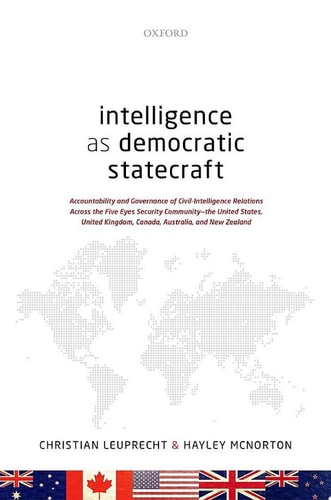
Intelligence as Democratic Statecraft: Accountability and Governance of Civil-Intelligence Relations Across the Five Eyes Security Community
0
0
As an Amazon Associate and affiliate partner, Menrva Books earns from qualifying purchases. Learn more
Author Description
This book features a comparative study in intelligence accountability and governance across the Five Eyes: the imperative for member countries of the world's most powerful intelligence alliance to reconcile democracy and security through transparent standards, guidelines, legal frameworks, executive directives, and international law. It argues that intelligence accountability is best understood not as an end in itself but as a means that is integral democratic governance. On the one hand, to assure the executive of government and the public that the activities of intelligence agencies are lawful and, if not, to identify breaches in compliance. On the other hand, to raise awareness of and appreciation for the intelligence function, and whether it is being carried out in the most effective, efficient, and innovative way possible to achieve its objective. The analysis shows how the addition of legislative and judicial components to executive and administrative accountability has been shaping evolving institutions, composition, practices, characteristics, and cultures of intelligence oversight and review in the United States, the United Kingdom, Canada, Australia, and New Zealand using a most-similar systems design. Democracies are engaged in an asymmetric struggle against unprincipled adversaries. Technological change is enabling unprecedented social and political disruption. These threat vectors have significantly affected, altered, and expanded the role, powers and capabilities of intelligence organizations. Accountability aims to reassure sceptics that intelligence and security practices are indeed aligned with the rules and values that democracies claim to defend.
Menrva's Summary
THE THESIS
How can democratic nations effectively reconcile the inherent tension between national security requirements and the necessity for transparent, accountable governance within intelligence agencies? Christian Leuprecht and Hayley McNorton examine the evolution of oversight mechanisms across the Five Eyes alliance, arguing that accountability is not merely a procedural hurdle but a fundamental component of democratic legitimacy. By analyzing the interplay between executive, legislative, and judicial oversight, the authors demonstrate how these nations attempt to ensure that intelligence activities remain lawful, efficient, and aligned with democratic values while facing modern, asymmetric threats.
THE SCOPE MAP
What You Will Find
- Comparative analysis of intelligence oversight frameworks in the United States, United Kingdom, Canada, Australia, and New Zealand.
- Examination of the shift from purely executive-led oversight to the inclusion of legislative and judicial review.
- Assessment of how technological disruption and evolving threat vectors influence intelligence agency powers.
Scope Limits
- The analysis focuses primarily on the Five Eyes alliance and does not provide a global survey of intelligence governance models.
- The text prioritizes institutional and legal structures over the operational details of specific intelligence missions.
THE AUTHORITY PERSPECTIVE
Experts identify this work as a significant contribution to the field of comparative intelligence studies, particularly for its rigorous application of a most-similar systems design. Readers frequently note the academic density of the prose, which makes it a valuable resource for scholars and policy practitioners interested in the intersection of security and democratic accountability.
Page Count:
260
Publication Date:
2021-01-01
Publisher:
OUP Oxford
ISBN-10:
0192646184
ISBN-13:
9780192646187
Security Studies
Law
International relations
Governance
Comparative Politics
Community Tags
Other Editions(2)
Similar Books




Reader Comments
Share Your Thoughts
No comments yet. Be the first to share your thoughts!