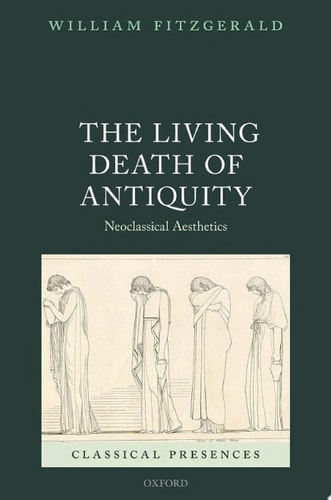
The Living Death of Antiquity: Neoclassical Aesthetics
0
0
As an Amazon Associate and affiliate partner, Menrva Books earns from qualifying purchases. Learn more
Author Description
The Living Death of Antiquity examines the idealization of an antiquity that exhibits, in the words of Johann Joachim Winckelmann, 'a noble simplicity and quiet grandeur'. Fitzgerald discusses the aesthetics of this strain of neoclassicism as manifested in a range of work in different media and periods, focusing on the late eighteenth and early nineteenth centuries. In the aftermath of Winckelmann's writing, John Flaxman's engraved scenes from the Iliad and the sculptors Antonio Canova and Bertel Thorvaldsen reinterpreted ancient prototypes or invented new ones. Earlier and later versions of this aesthetic in the ancient Greek Anacreontea, the French Parnassian poets and Erik Satie's Socrate, manifest its character in different media and periods. Looking with a sympathetic eye on the original aspirations of the neoclassical aesthetic and its forward-looking potential, Fitzgerald describes how it can tip over into the vacancy or kitsch through which a 'remaindered' antiquity lingers in our minds and environments. This book asks how the neoclassical value of simplicity serves to conjure up an epiphanic antiquity, and how whiteness, in both its literal and its metaphorical forms, acts as the 'logo' of neoclassical antiquity, and functions aesthetically in a variety of media. In the context of the waning of a neoclassically idealized antiquity, Fitzgerald describes the new contents produced by its asymptotic approach to meaninglessness, and how the antiquity that it imagined both is and is not with us.
Menrva's Summary
THE THESIS
This work investigates how the neoclassical ideal of simplicity and quiet grandeur, as defined by Johann Joachim Winckelmann, functions as both an aesthetic aspiration and a potential descent into vacancy or kitsch. William Fitzgerald, a scholar of classical literature and reception, utilizes a cross-disciplinary approach to analyze how neoclassical values were manifested in sculpture, engraving, poetry, and music. He argues that the 'whiteness' of antiquity serves as a foundational logo for this aesthetic, exploring how this idealized past persists in modern consciousness even as its original meanings wane.
THE SCOPE MAP
What You Will Find
- Analysis of late eighteenth and early nineteenth-century neoclassical works
- Comparative studies of John Flaxman, Antonio Canova, and Bertel Thorvaldsen
- Examination of the Anacreontea, French Parnassian poetry, and Erik Satie's Socrate
- Theoretical inquiry into the role of whiteness as a metaphorical and literal aesthetic marker
Scope Limits
- Does not provide a comprehensive history of all neoclassical art movements
- Focuses primarily on the reception of antiquity rather than archaeological accuracy
THE AUTHORITY PERSPECTIVE
Scholars and critics recognize this text as a nuanced contribution to the study of classical reception and the philosophy of aesthetics. Readers frequently note the academic density of the prose, which is well-suited for advanced students and researchers in art history and classical studies.
Page Count:
284
Publication Date:
2022-01-01
Publisher:
OUP Oxford
ISBN-10:
0192646222
ISBN-13:
9780192646224
History of Architecture
Cultural History
Neoclassicism
Philosophy of
Professional Career & Trade
Art History
Aesthetics
Community Tags
Similar Books