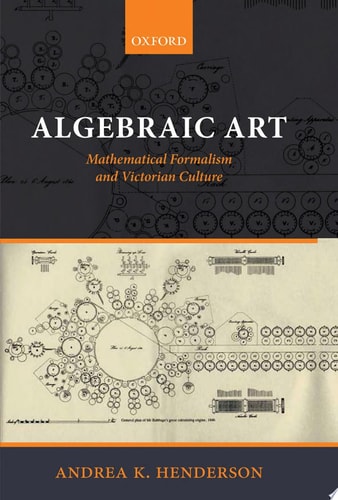
Algebraic Art
0
0
As an Amazon Associate and affiliate partner, Menrva Books earns from qualifying purchases. Learn more
Author Description
Algebraic Art Explores The Invention Of A Peculiarly Victorian Account Of The Nature And Value Of Aesthetic Form, And It Traces That Account To A Surprising Source: Mathematics. The Nineteenth Century Was A Moment Of Extraordinary Mathematical Innovation, Witnessing The Development Of Non-euclidean Geometry, The Revaluation Of Symbolic Algebra, And The Importation Of Mathematical Language Into Philosophy. All These Innovations Sprang From A Reconception Of Mathematics As A Formal Rather Than A Referential Practice—as A Means For Describing Relationships Rather Than Quantities. For Victorian Mathematicians, The Value Of A Claim Lay Not In Its Capacity To Describe The World But Its Internal Coherence. This Concern With Formal Structure Produced A Striking Convergence Between Mathematics And Aesthetics: Geometers Wrote Fables, Logicians Reconceived Symbolism, And Physicists Described Reality As Consisting Of Beautiful Patterns. Artists, Meanwhile, Drawing Upon The Cultural Prestige Of Mathematics, Conceived Their Work As A 'science' Of Form, Whether As Lines In A Painting, Twinned Characters In A Novel, Or Wavelike Stress Patterns In A Poem. Avant-garde Photographs And Paintings, Fantastical Novels Like Flatland And Lewis Carroll's Children's Books, And Experimental Poetry By Swinburne, Rossetti, And Patmore Created Worlds Governed By A Rigorous Internal Logic Even As They Were Pointedly Unconcerned With Reference Or Realist Protocols. Algebraic Art Shows That Works We Tend To Regard As Outliers To Mainstream Victorian Culture Were Expressions Of A Mathematical Formalism That Was Central To Victorian Knowledge Production And That Continues To Shape Our Understanding Of The Significance Of Form.
Menrva's Summary
THE THESIS
This book investigates the historical convergence between Victorian mathematical innovation and the development of formalist aesthetics in nineteenth-century literature and art. Andrea K. Henderson, a scholar of Victorian literature, utilizes archival research and historical analysis to argue that the shift toward symbolic algebra and non-Euclidean geometry fundamentally altered how artists and writers conceptualized the value of form. She posits that the Victorian move toward internal coherence over referential representation was a direct byproduct of the era's mathematical advancements.
THE SCOPE MAP
What You Will Find
- Analysis of nineteenth-century mathematical shifts including non-Euclidean geometry and symbolic algebra.
- Examination of literary works by Lewis Carroll, Swinburne, Rossetti, and Patmore.
- Discussion of visual arts, including avant-garde photography and painting.
- Exploration of the 'science of form' as a cultural phenomenon.
Scope Limits
- The text does not provide a comprehensive history of all Victorian mathematics.
- It does not focus on mainstream realist literature, concentrating instead on works that prioritize formalist logic.
THE AUTHORITY PERSPECTIVE
Scholars recognize this work as a significant contribution to the study of interdisciplinary connections between the sciences and the humanities in the nineteenth century. Readers frequently note the academic density of the prose, which requires a foundational understanding of both Victorian literary history and mathematical philosophy.
Page Count:
248
Publication Date:
2018-01-01
Publisher:
Oxford University Press
ISBN-10:
0192538055
ISBN-13:
9780192538055
Cultural History
Philosophy of
Aesthetics
Mathematics history
Literary Criticism
Community Tags
Similar Books