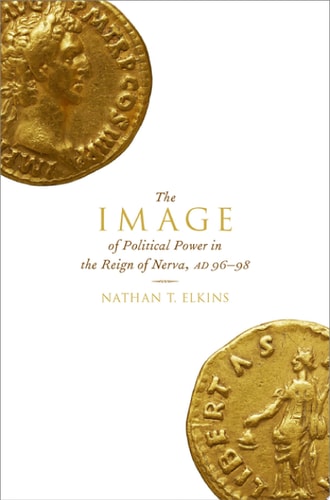
The Image of Political Power in the Reign of Nerva, AD 96-98
0
0
As an Amazon Associate and affiliate partner, Menrva Books earns from qualifying purchases. Learn more
Author Description
At age 65, Nerva assumed the role of emperor of Rome; just sixteen months later, his reign ended with his death. Nerva's short reign robbed his regime of the opportunity for the emperor's imperial image to be defined in building or monumental art, leaving seemingly little for the art historian or archaeologist to consider. In view of this paucity, studies of Nerva primarily focus on the historical circumstances governing his reign with respect to the few relevant literary sources. The Image of Political Power in the Reign of Nerva, AD 96-98, by contrast, takes the entire imperial coinage program issued by the mint of Rome to examine the "self-representation," and, by extension, the policies and ideals of Nerva's regime. The brevity of Nerva's reign and the problems of retrospection caused by privileging posthumous literary sources make coinage one of the only ways of reconstructing anything of his image and ideology as it was disseminated and developed at the end of the first century during the emperor's lifetime. The iconography of this coinage, and the popularity and spread of different iconographic types-as determined by study of hoards and finds, and as targeted towards different ancient constituencies-offers a more positive take on a little-studied emperor. Across three chapters, Elkins traces the different reverse types and how they would have resonated with their intended audiences, concluding with an examination of the parallels between text and coin iconography with previous and subsequent emperors. The Image of Political Power in the Reign of Nerva, AD 96-98 thus offers significant new perspectives on the agents behind the selection and formulation of iconography in the late first and early second century, showing how coinage can act as a visual panegyric similar to contemporary laudatory texts by tapping into how the inner circle of Nerva's regime wished the emperor to be seen.
Menrva's Summary
THE THESIS
How did the short-lived reign of Emperor Nerva utilize imperial coinage to construct and disseminate a specific political image and ideology? Nathan T. Elkins, a scholar of Roman numismatics and history, investigates the limited visual record of Nerva's sixteen-month rule. By analyzing the entire imperial coinage program issued by the Rome mint, Elkins argues that these coins served as a deliberate visual panegyric, revealing the regime's intended self-representation and policy goals in the absence of monumental architecture.
THE SCOPE MAP
What You Will Find
- Comprehensive analysis of the imperial coinage program issued during Nerva's reign (AD 96-98).
- Examination of iconographic types and their distribution patterns based on hoard and find data.
- Comparative study of coin iconography alongside contemporary literary sources and the practices of preceding and succeeding emperors.
Scope Limits
- The study does not focus on monumental art or building projects, as these were largely absent due to the brevity of Nerva's reign.
- The analysis is restricted to the Roman mint's output and does not extensively cover provincial coinage variations.
THE AUTHORITY PERSPECTIVE
Scholars and historians recognize this work as a significant contribution to the study of Roman imperial ideology, particularly for its innovative use of numismatic evidence to fill gaps left by traditional literary sources. Readers frequently note the academic density of the prose, which provides a rigorous methodology for interpreting visual propaganda in the ancient world.
Page Count:
223
Publication Date:
2017-01-01
Publisher:
Oxford University Press
ISBN-10:
0190648058
ISBN-13:
9780190648053
History
Archaeology
Art History
Rome
Ancient - Rome
Numismatics
History of Architecture
Professional Career & Trade
Humanities
Community Tags
Other Editions(2)
Similar Books


Reader Comments
Share Your Thoughts
No comments yet. Be the first to share your thoughts!