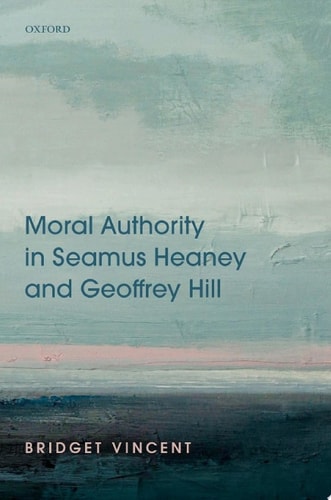
Moral Authority in Seamus Heaney and Geoffrey Hill
0
0
As an Amazon Associate and affiliate partner, Menrva Books earns from qualifying purchases. Learn more
Author Description
How do poems communicate moral ideas? Can they express concepts in ways that are unique and impossible to replicate in other forms of writing? This book explores these questions by turning to two of the late twentieth century's most important poets: Seamus Heaney and Geoffrey Hill. Their work shows that a poem can act as an example of a moral concept, rather than simply a description or discussion of it. Exploring these two poets via their shared preoccupation with poetry's moral exemplarity opens up new perspectives on their work. The concept of exemplarity is shown to play an important role in these poets' most significant preoccupations, from moral complicity to the nature of lyric speech to literary influence to memorialisation, responsibility, and aesthetic autonomy. Through this new analysis of poetry, critical prose, drama, and archival materials, this book offers a major new study of ethics in the later period of these two writers--including recent underexplored posthumous works. In turn, the book also makes an important intervention in larger debates about literature and morality, and about the field of ethical criticism itself: this is the first book-length study to expand ethical criticism beyond its customary narrative focus. The ethical criticism of fiction is often an exercise in methodological advocacy, urging the use of more literary examples in moral philosophy. As this book shows, including poetry among these examples introduces new, lyric-inflected caveats about the use of literature as a form of moral example: caveats which remain invisible in narrative-centred ethical criticism.
Menrva's Summary
THE THESIS
How do poems communicate moral ideas, and can they express concepts in ways unique to the poetic form? Bridget Vincent investigates this question by analyzing the work of Seamus Heaney and Geoffrey Hill, arguing that their poetry functions as an embodiment of moral concepts rather than a mere description of them. Drawing on a wide range of primary sources, including poetry, critical prose, drama, and archival materials, Vincent challenges the narrative-centric focus of traditional ethical criticism.
THE SCOPE MAP
What You Will Find
- A comparative analysis of moral exemplarity in the works of Seamus Heaney and Geoffrey Hill.
- An exploration of themes including moral complicity, lyric speech, literary influence, and aesthetic autonomy.
- A methodological expansion of ethical criticism to include lyric poetry alongside traditional narrative forms.
Scope Limits
- The study is restricted to the later periods of Heaney and Hill's careers.
- The analysis does not attempt a comprehensive biography of either poet, focusing instead on their ethical frameworks.
THE AUTHORITY PERSPECTIVE
Scholars recognize this text as a significant intervention in the field of ethical criticism, specifically for its departure from narrative-focused methodologies. Experts highlight the book's utility in bridging the gap between poetic analysis and moral philosophy.
Page Count:
222
Publication Date:
2022-01-01
Publisher:
OUP Oxford
ISBN-10:
0192644254
ISBN-13:
9780192644251
Poetry
Academic
English poetry
Criticism and interpretationHill Geoffrey
Literary Criticism
Literary theory
English & College Success
English
Poetry
Ethics
English literature
Community Tags
Similar Books