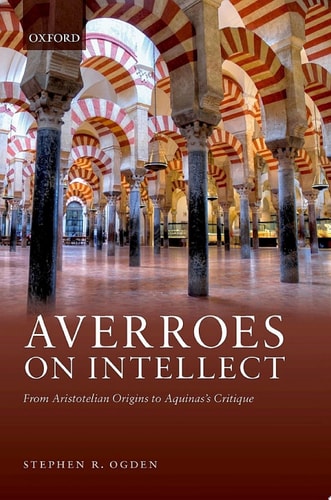
Averroes on Intellect: From Aristotelian Origins to Aquinas' Critique
0
0
As an Amazon Associate and affiliate partner, Menrva Books earns from qualifying purchases. Learn more
Author Description
Averroes on Intellect provides a detailed analysis of the Muslim philosopher Averroes (Ibn Rushd)'s notorious unicity thesis -- the view that there is only one separate and eternal intellect for all human beings. It focuses directly on Averroes' arguments, both from the text of Aristotle's De Anima and, more importantly, his own philosophical arguments in the Long Commentary on the De Anima. Stephen Ogden defends Averroes' interpretation of De Anima using a combination of Greek, Arabic, Latin, and contemporary sources. Yet, Ogden also insists that Averroes is not merely a 'commentator' but an incisive philosopher in his own right. The author thus reconstructs and analyzes Averroes' two most significant independent philosophical arguments, the Determinate Particular Argument and the Unity Argument. Alternative ancient and medieval views are also considered throughout, especially from two important foils before and after Averroes, namely, Avicenna (Ibn Sina) and Thomas Aquinas. Aquinas' most famous and penetrating arguments against the unicity thesis are also addressed. Finally, Ogden considers Averroes' own objections to broader metaphysical views of the soul like Avicenna's and Aquinas', which agree with him on several key points including the immateriality of the intellect and the individuation of human souls by matter, while still diverging on the number and substantial nature of the intellect. The central goal of this book is to provide readers with a single study of Averroes' most pivotal arguments on intellect, consolidating and building on recent scholarship and offering a comprehensive case for his unicity thesis in the wider context of Aristotelian epistemology and metaphysics.
Menrva's Summary
THE THESIS
This book investigates the philosophical validity and historical impact of Averroes' unicity thesis, which posits that a single, separate, and eternal intellect exists for all human beings. Stephen R. Ogden, a scholar of medieval philosophy, utilizes a rigorous analytical framework to examine Averroes' arguments within the context of Aristotelian tradition. By synthesizing Greek, Arabic, and Latin source materials, the author reconstructs the philosopher's primary arguments while contrasting them with the perspectives of Avicenna and Thomas Aquinas.
THE SCOPE MAP
What You Will Find
- Analysis of the Determinate Particular Argument and the Unity Argument.
- Comparative study of Aristotelian, Avicennian, and Thomistic metaphysical frameworks.
- Examination of the Long Commentary on the De Anima.
- Evaluation of the immateriality of the intellect and the individuation of souls.
Scope Limits
- The text does not provide a general biography of Averroes, focusing strictly on his epistemology and philosophy of mind.
- It does not cover the entirety of Averroes' scientific or legal writings.
THE AUTHORITY PERSPECTIVE
Experts recognize this work as a precise reconstruction of Averroes' intellectual position within the medieval philosophical landscape. Readers frequently note the academic density of the prose, which serves as a specialized resource for students of Aristotelian and scholastic thought.
Page Count:
295
Publication Date:
2022-01-01
Publisher:
OUP Oxford
ISBN-10:
0192649469
ISBN-13:
9780192649461
Philosophy
Metaphysics
Islamic Philosophy
Epistemology
Community Tags
Similar Books