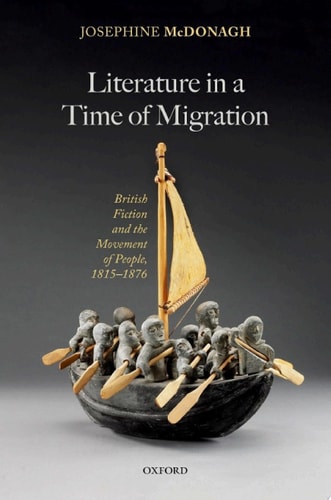
Literature in a Time of Migration: British Fiction and the Movement of People, 1815–1876
0
0
As an Amazon Associate and affiliate partner, Menrva Books earns from qualifying purchases. Learn more
Author Description
Literature in a Time of Migration offers a profound rethinking of British fiction in light of the new practices of human mobility that reshaped the nineteenth-century world. Building on the growing critical engagement with globalization in literary studies, it confronts the paradox that at a time when transnational human movement occurred globally on an unprecedented scale, British fiction appeared to turn inward to tell stories of local places that valorized stability and rootedness. In contrast, this book reveals how literary works, from the end of the Napoleonic Wars to the advent of the New Imperialism, were active components of a culture of colonization and emigration. Fictional texts, as print commodities, were enmeshed in technologies of transport and communication, and innovations in literary form were spurred by the conditions and consequences of human movement. Examining works by Scott, Charlotte Brontë, Dickens, and George Eliot, as well as popular contemporaries, Mary Russell Mitford, John Galt, and Thomas Martin Wheeler, this volume demonstrates how literary texts overlap with an agenda set in public discussions of colonial emigration that they also helped to shape. Debates about assisted emigration, 'forced' and 'free' migration, colonization, settlement, and the removal of native peoples, figure in fictions in complex ways. Read alongside writings by emigration theorists, practitioners, and enthusiasts for colonization, fictional texts reveal a powerful and sustained engagement with British migratory practices and their worldwide consequences. Literature in a Time of Migration is a timely reminder of the place and importance of migration within British cultural heritage.
Menrva's Summary
THE THESIS
How did nineteenth-century British fiction reconcile the era's unprecedented global human mobility with a narrative focus on local stability and rootedness? Josephine McDonagh, a scholar of nineteenth-century literature, argues that British novels of this period were not merely inward-looking but were active participants in the culture of colonization and emigration. By analyzing the intersection of print culture, transport technologies, and imperial policy, she demonstrates that literary forms were fundamentally shaped by the conditions of human movement between 1815 and 1876.
THE SCOPE MAP
What You Will Find
- Analysis of major authors including Scott, Charlotte Brontë, Dickens, and George Eliot.
- Examination of popular contemporary writers such as Mary Russell Mitford, John Galt, and Thomas Martin Wheeler.
- Investigation into the relationship between literary texts and public discourse on assisted emigration and colonial settlement.
- Discussion of the role of print commodities in the broader infrastructure of imperial expansion.
Scope Limits
- The study is strictly bounded by the period from the end of the Napoleonic Wars to the onset of New Imperialism.
- The analysis focuses primarily on British fiction and does not provide an exhaustive survey of colonial or indigenous literary responses.
THE AUTHORITY PERSPECTIVE
Scholars in the field of Victorian studies recognize this work as a significant contribution to the understanding of how literature interacts with imperial history and globalization. Readers frequently note the academic density of the prose and the rigorous archival research that connects fictional narratives to contemporary emigration theory.
Page Count:
355
Publication Date:
2021-01-01
Publisher:
OUP Oxford
ISBN-10:
0192648861
ISBN-13:
9780192648860
English & College Success
Migration Studies
Cultural History
British History
English
Nineteenth century
Literary Criticism
Community Tags
Similar Books


![The Remoter rural areas of Britain: [a symposium held at the University of Newcastle upon Tyne, 1970];](https://storage.googleapis.com/menrva_img_storage/covers/9780050024713.jpg)