
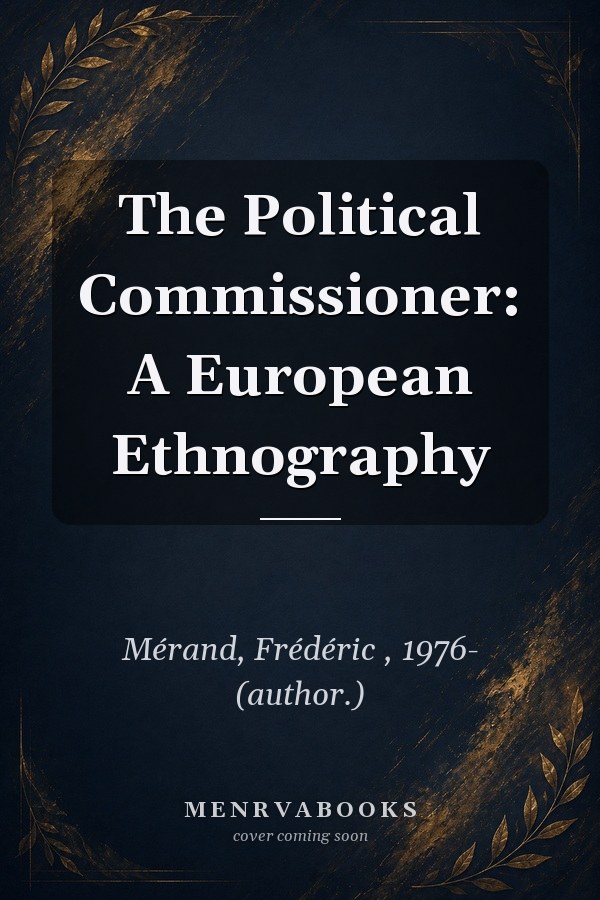
The Political Commissioner: A European Ethnography
0
0
As an Amazon Associate and affiliate partner, Menrva Books earns from qualifying purchases. Learn more
Author Description
Based on four years of embedded observation in the cabinet of a European Commissioner, this book develops a sociology of international political work. Empirically, it offers an insider's chronicle of the European Union between 2015 and 2019. The analysis traces the successes and failures of Commissioner Pierre Moscovici and his team on five issues that defined European politics between 2015 and 2019: the Greek crisis, budgetary disputes with Spain and Portugal, the rise of populism in Italy, the reform of the eurozone, and the fight against tax evasion. The aim is not to ascertain whether the Commission's policy was good or bad, but to understand how political work is done in a European Union where the 'spectacle of power' is blurred by 24 official languages, 28 national histories, a powerful technocracy, and sometimes opaque institutions. As a life-long socialist politician and former French finance minister, Pierre Moscovici was perhaps the most intensely political character in Jean-Claude Juncker's self-styled 'Political Commission'. Brandishing his leftist identity, rejecting technocratic talk, he surrounded himself with staffers sharing his ambition - but also critical of his actions. Shadowing them from the corridors of the Berlaymont, the seat of the European Commission, to Washington and Athens, The Political Commissioner throws light on the partisan struggles that shaped the Juncker Commission, tensions with the Eurogroup and the Parliament, and recurring conflicts with the Member States. It also shows how political staffers operate informally and in their interaction with the media and civil servants, as they craft and sell public policies to the public. In this ethnographic narrative, French politics is never far away. Decoding the European policy of a French, Socialist Commissioner, first under François Hollande and then Emmanuel Macron, the book investigates the dynamics that sometimes bring Brussels and Paris together, sometimes set them apart.
Menrva's Summary
THE THESIS
How is political work actually performed within the complex, multi-layered bureaucracy of the European Union? Frédéric Mérand, a political sociologist, utilizes four years of embedded ethnographic observation within the cabinet of Commissioner Pierre Moscovici to analyze the mechanics of international governance. The book argues that the European Commission functions not merely as a technocratic machine, but as a site of intense partisan struggle, personal ambition, and informal negotiation between national and supranational interests.
THE SCOPE MAP
What You Will Find
- Detailed analysis of five key policy areas: the Greek crisis, eurozone reform, tax evasion, and budgetary disputes with Spain and Portugal.
- An ethnographic account of daily operations within the Berlaymont, including interactions between staffers, media, and civil servants.
- A sociological framework for understanding the intersection of national political identities and European institutional constraints.
Scope Limits
- The text does not provide a normative evaluation of whether the Commission's policies were objectively successful or failed.
- The analysis is specifically bounded by the 2015-2019 period and the specific cabinet of Pierre Moscovici.
THE AUTHORITY PERSPECTIVE
Experts recognize this work as a rare, high-access ethnographic study that demystifies the internal culture of the European Commission. Readers frequently note that the text provides a unique, granular perspective on the intersection of French national politics and European institutional governance.
Page Count:
244
Publication Date:
2021-01-01
Publisher:
OUP Oxford
ISBN-10:
0192646249
ISBN-13:
9780192646248
International relations
Sociology
European Union
Ethnography
Governance
Community Tags
Other Editions(2)
Similar Books











Reader Comments
Share Your Thoughts
No comments yet. Be the first to share your thoughts!