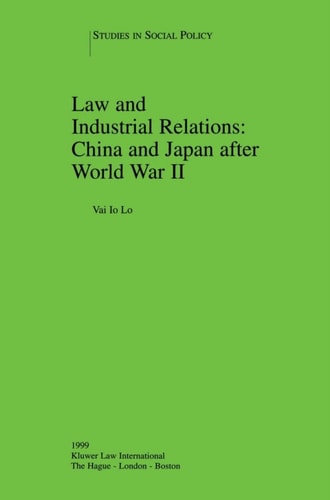
Law and Industrial Relations
0
0
As an Amazon Associate and affiliate partner, Menrva Books earns from qualifying purchases. Learn more
Author Description
Chinese and Japanese trade unions may seem emasculated and weak when compared with their Western counterparts in that they do not stand up to management to protect the interests of workers. The author's careful analysis probes the reasons for this difference, tearing down stereotypical notions about societies with a Confucian heritage, to examine the significant role of law in shaping industrial relations in modern China and Japan. Through a comparative analysis of their trade union laws, this work analyses the role of law in shaping postwar industrial relations in China and Japan and the interplay amongst such elements as the State or the Party, management, and workers. The work focuses on industrial relations in commercial and industrial enterprises, addressing such issues as the performance or nonperformance of trade unions in China and Japan and possible explanations, and the prospects and limitations of using codified laws to effect change or control in the postwar industrial settings of these two countries. The work's helpful features include a comparative approach, the use of case studies to maximize objectivity and insight, a unified and clearly expressed thesis and conclusions including a summary of findings, footnotes and cross references, an index, and concise explanations of the relevant legal provisions and the manner in which they have been applied.
Menrva's Summary
THE THESIS
This work investigates the role of law in shaping industrial relations in modern China and Japan, challenging stereotypical notions about Confucian heritage societies. The author, Vai Io Lo, analyzes the comparative trade union laws of China and Japan to understand why their trade unions appear less assertive than their Western counterparts. The study examines the interplay between the State/Party, management, and workers, focusing on the performance and non-performance of trade unions in commercial and industrial enterprises. It further explores the potential and limitations of codified laws in effecting change within the postwar industrial settings of these two nations.
THE SCOPE MAP
- Comparative analysis of trade union laws in China and Japan
- Examination of the State/Party, management, and worker dynamics
- Case studies to maximize objectivity and insight
- Analysis of trade union performance and non-performance
- Discussion on the use of codified laws for change and control
- Explanation of relevant legal provisions and their application
- Summary of findings with a unified thesis and conclusions
THE AUTHORITY PERSPECTIVE
The book offers a comparative analysis of trade union laws in China and Japan, utilizing case studies and legal explanations to support its thesis. The author aims to dismantle stereotypes about societies with a Confucian heritage by examining the significant role of law in shaping industrial relations. The work is structured to provide clear conclusions and a summary of findings, with helpful features such as footnotes, cross-references, and an index. The approach is designed to maximize objectivity and insight into the postwar industrial settings of these two countries.
Page Count:
960
Publication Date:
1997-01-01
Publisher:
Kluwer Law International B.V.
ISBN-10:
9041180834
ISBN-13:
9789041180834
Non-Fiction
Politics
History
Comparative Law
Labor Relations
Asian Studies
Law
Community Tags
Similar Books