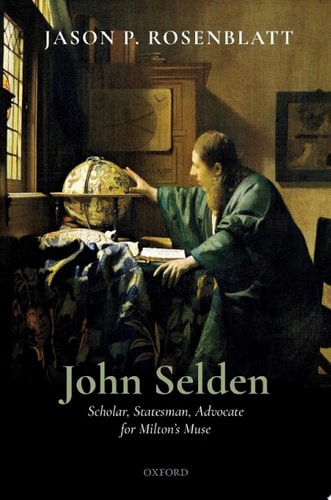
John Selden: Scholar, Statesman, Advocate for Milton's Muse
0
0
As an Amazon Associate and affiliate partner, Menrva Books earns from qualifying purchases. Learn more
Author Description
The life of John Selden (1584-1654) was both contemplative and active. Seventeenth-century England's most learned person, he was also one of the few survivors who continued in the Long Parliament of the 1640s his vigorous opposition, begun in the 1620s, to abuses of power, whether by Charles I or, later, by the Presbyterian-controlled Westminster Assembly. His gift for finding analogies among different cultures--Greco-Roman, Christian, Jewish, and Islamic--helped to transform both the poetry and prose of the century's greatest poet, John Milton. Regarding family law, the two might have influenced one another. Milton cites Selden, and Selden owned two of Milton's treatises on divorce, published in 1645, both of them presumably acquired while he was writing Uxor Ebraica (1646). Selden accepted the non-biblically rabbinic, externally imposed, coercive Adamic/Noachide precepts as universal laws of perpetual obligation, rejecting his predecessor Hugo Grotius' view of natural law as the innate result of right reason. He employed rhetorical strategies in De Jure Naturali et Gentium (The Law of Nature and of Nations) to prepare his readers for what might otherwise have shocked them. Although Selden was very active in the Long Parliament, his only surviving debates from that decade were as a lay member of the Westminster Assembly of Divines. The Assembly's scribe left so many gaps that the transcript is sometimes indecipherable. This book fills in the gaps and makes the speeches coherent by finding their contexts in Selden's printed works, both the scholarly, as in the massive De Synedriis, but also in the witty and informal Table Talk.
Menrva's Summary
THE THESIS
This work investigates how the intellectual contributions of John Selden, a prominent 17th-century scholar and statesman, shaped the political and literary landscape of his era, particularly in his interactions with John Milton. Jason Philip Rosenblatt, a scholar of early modern literature, utilizes a synthesis of Selden's published treatises, parliamentary records, and personal library holdings to argue that Selden's unique comparative approach to law and culture provided a critical framework for Milton's own intellectual development. By reconstructing fragmented transcripts from the Westminster Assembly, the author demonstrates how Selden's legal theories regarding natural law and family structures influenced the period's most significant debates.
THE SCOPE MAP
What You Will Find
- Analysis of Selden's influence on John Milton's prose and poetry.
- Reconstruction of debates from the Westminster Assembly of Divines.
- Comparative study of Greco-Roman, Christian, Jewish, and Islamic legal traditions.
- Examination of Selden's rejection of Grotius's natural law theory in favor of Adamic/Noachide precepts.
Scope Limits
- The text focuses primarily on the intellectual and political intersections between Selden and Milton rather than providing a comprehensive, day-to-day biography of Selden's entire life.
THE AUTHORITY PERSPECTIVE
Scholars in the field of early modern studies recognize this book as a rigorous attempt to bridge the gap between legal history and literary analysis. Readers frequently note the academic density of the prose, which assumes a high level of familiarity with 17th-century political and theological discourse.
Page Count:
288
Publication Date:
2021-01-01
Publisher:
OUP Oxford
ISBN-10:
0192654551
ISBN-13:
9780192654557
History
Biography
17th Century
Legal History
Literary Criticism
English & College Success
English
English literature
Influence Literary artistic etc
Community Tags
Similar Books