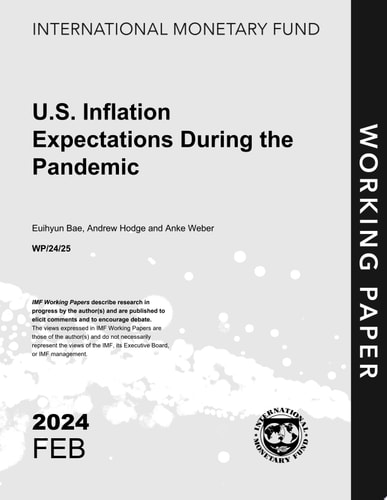
U.S. Inflation Expectations During the Pandemic
0
0
As an Amazon Associate and affiliate partner, Menrva Books earns from qualifying purchases. Learn more
Author Description
This paper studies how and why inflation expectations have changed since the emergence of Covid-19. Using micro-level data from the University of Michigan Survey of Consumers, we show that the distribution of consumer expectations at one-year and five-ten year horizons has widened since the surge of inflation during 2021, along with the mean. Persistently high and heterogeneous expectations of consumers with less education and lower income are mainly responsible. A simple model of adaptive learning is able to mimic the change in inflation expectations over time for different demographic groups. The inflation expectations of low income and female consumers are consistent with using less complex forecasting models and are more backward-looking. A medium-scale DSGE model with adaptive learning, estimated during 1965-2022, has a time-varying solution that produces lower forecast errors for inflation than a variant with rational expectations. The estimated model interprets the surge of inflation in 2021 mainly as the result of a price markup shock, which is more persistent and requires a larger and more persistent monetary policy response than under rational expectations.
Menrva's Summary
THE THESIS
This paper investigates the drivers and evolution of U.S. inflation expectations during the COVID-19 pandemic. The authors utilize micro-level data from the University of Michigan Survey of Consumers to demonstrate that the distribution of consumer inflation expectations has widened since the 2021 inflation surge, with persistently high and heterogeneous expectations among less educated and lower-income individuals being a primary factor. A model of adaptive learning is employed to replicate these observed changes across demographic groups, suggesting that lower-income and female consumers may use simpler, more backward-looking forecasting methods. The study further incorporates a medium-scale DSGE model, estimated over a long historical period, to analyze the impact of shocks and policy responses.
THE SCOPE MAP
- Analysis of U.S. inflation expectations using micro-level data from the University of Michigan Survey of Consumers.
- Examination of how the distribution and mean of one-year and five-ten year inflation expectations have changed since the COVID-19 pandemic.
- Identification of demographic groups (less educated, lower income, female consumers) with persistently high and heterogeneous inflation expectations.
- Application of a simple adaptive learning model to mimic changes in inflation expectations across different demographic groups.
- Investigation into the forecasting models used by consumers, with a focus on backward-looking approaches for lower-income and female consumers.
- Estimation of a medium-scale DSGE model with adaptive learning (1965-2022) to analyze inflation dynamics.
- Interpretation of the 2021 inflation surge as a persistent price markup shock within the DSGE model.
- Comparison of monetary policy responses under adaptive learning versus rational expectations.
THE AUTHORITY PERSPECTIVE
The study provides a detailed econometric analysis of U.S. inflation expectations, focusing on the impact of the COVID-19 pandemic and subsequent inflation surge. The authors' use of micro-level survey data allows for a granular examination of how different demographic groups perceive and forecast inflation. The integration of adaptive learning models, both simple and within a DSGE framework, offers insights into consumer forecasting behavior and the implications for monetary policy. The research suggests that shocks, such as price markups, can have more persistent effects and necessitate different policy responses than traditional rational expectations models might predict.
Page Count:
48
Publication Date:
2024-02-09
Publisher:
International Monetary Fund
ISBN-13:
9798400266867
Non-Fiction
Economics
Finance
Consumer Behavior
Inflation
Community Tags
Similar Books