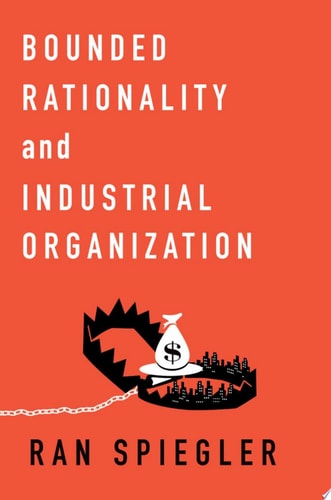
Bounded Rationality and Industrial Organization
0
0
As an Amazon Associate and affiliate partner, Menrva Books earns from qualifying purchases. Learn more
Author Description
Conventional economic theory assumes that consumers are fully rational, that they have well-defined preferences and easily understand the market environment. Yet, in fact, consumers may have inconsistent, context-dependent preferences or simply not enough brain-power to evaluate and compare complicated products. Thus the standard model of consumer behavior-which depends on an ideal market in which consumers are boundlessly rational-is called into question. While behavioral economists have for some time confirmed and characterized these inconsistencies, the logical next step is to examine the implications they have in markets.Grounded in key observations in consumer psychology, Bounded Rationality and Industrial Organization develops non-standard models of "boundedly rational" consumer behavior and embeds them into familiar models of markets. It then rigorously analyses each model in the tradition of microeconomic theory, leading to a richer, more realistic picture of consumer behavior. Ran Spiegler analyses phenomena such as exploitative price plans in the credit market, complexity of financial products and other obfuscation practices, consumer antagonism to unexpected price increases, and the role of default options in consumer decision making. Spiegler unifies the relevant literature into three main strands: limited ability to anticipate and control future choices, limited ability to understand complex market environments, and sensitivity to reference points.Although the challenge of enriching the psychology of decision makers in economic models has been at the frontier of theoretical research in the last decade, there has been no graduate-level, theory-oriented textbook to cover developments in the last 10-15 years. Thus, Bounded Rationality and Industrial Organization offers a welcome and crucial new understanding of market behavior-it challenges conventional wisdom in ways that are interesting and economically significant, and which in the end effect the well-being of consumers.
Menrva's Summary
THE THESIS
This book investigates how the integration of boundedly rational consumer behavior into standard microeconomic models alters our understanding of market dynamics and industrial organization. Ran Spiegler, a prominent theorist in behavioral economics, addresses the limitations of the traditional rational-agent model by incorporating psychological insights into formal economic frameworks. The text provides a rigorous, theory-oriented analysis of how consumer inconsistencies and cognitive constraints influence firm strategies and market outcomes. By bridging the gap between behavioral psychology and industrial organization, the author constructs a more nuanced model of modern market interactions.
THE SCOPE MAP
What You Will Find
- Formal microeconomic models incorporating limited consumer foresight and cognitive constraints.
- Analysis of firm strategies including obfuscation, complex pricing, and the use of default options.
- Theoretical examination of credit markets, financial product complexity, and consumer sensitivity to reference points.
- A structured synthesis of recent literature regarding the intersection of psychology and market theory.
THE AUTHORITY PERSPECTIVE
Experts identify this work as a primary graduate-level resource for students and researchers seeking a formal, theory-driven approach to behavioral industrial organization. Readers frequently note the technical density of the prose, which requires a strong foundation in microeconomic theory to fully grasp the mathematical models presented.
Page Count:
240
Publication Date:
2011-02-18
Publisher:
Oxford University Press
ISBN-10:
0195398718
ISBN-13:
9780195398717
Economics
Finance
Economic Theory
Decision Making
Principles of Microeconomics
Economics
Consumption Economics
Psychological aspects
Microeconomics
Consumer Behavior
Community Tags
Other Editions(3)
Similar Books











Reader Comments
Share Your Thoughts
No comments yet. Be the first to share your thoughts!