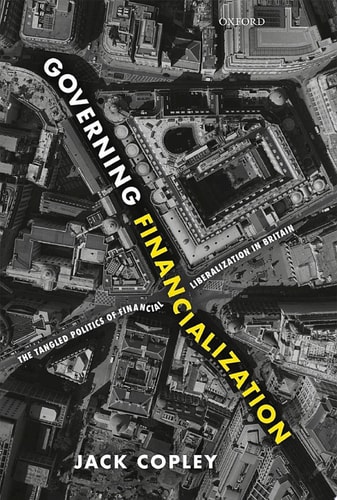
Governing Financialization: The Tangled Politics of Financial Liberalization in Britain
0
0
As an Amazon Associate and affiliate partner, Menrva Books earns from qualifying purchases. Learn more
Author Description
Capitalism has become 'financialized'. Since the 1970s, the swelling of financial markets and asset price bubbles has occurred alongside weaker underlying economic growth. Yet financialization was not a spontaneous market development - it was deeply political. States fuelled this process through policies of financial liberalization, and the British state lies at the heart of the story. Britain's radical financial liberalizations in the 1970s and 1980s were instrumental in creating a financialized global economic order in which the City of London emerged as a central hub. But why did the British state propel financialization? The conventional wisdom points to the lobbying power of financial elites and the strength of neoliberal ideology. However, Governing Financialization offers an alternative explanation through an in-depth exploration of declassified state archives. By examining key financial liberalizations in the 1970s and 1980s - including the notorious 'Big Bang' - this book argues that these policies were not part of an intentional scheme to create a new finance-led economic model. Instead, they were designed to address immediate governing dilemmas related to the grinding 'stagflation' crisis and its aftershocks. In this era, British governments found themselves trapped between global competitive pressures to enforce painful domestic adjustment and national political pressures to maintain existing living standards. Financial liberalization was pursued in a trial-and-error manner to navigate this dilemma. By unleashing financial markets, the state hoped to either postpone the worst effects of the crisis, or enact tough economic restructuring in an arm's-length fashion. Financialization was an accidental outcome, not an intentional result.
Menrva's Summary
THE THESIS
This book investigates why the British state actively promoted financial liberalization during the 1970s and 1980s, challenging the notion that financialization was a deliberate, ideologically driven project. Jack Copley, a scholar of political economy, utilizes newly declassified state archives to reconstruct the decision-making processes of British governments during the era of stagflation. He argues that liberalization was a reactive, trial-and-error strategy employed by policymakers to manage immediate governing dilemmas rather than a pre-planned transition to a finance-led economic model.
THE SCOPE MAP
What You Will Find
- Analysis of British financial policy during the 1970s and 1980s
- Examination of the 'Big Bang' and other key liberalization events
- Theoretical framework linking state governance to global economic pressures
Scope Limits
- Does not provide a comprehensive history of global financialization outside the British context
- Does not focus on the personal biographies of financial elites
THE AUTHORITY PERSPECTIVE
Experts recognize this work as a significant contribution to the study of political economy for its rigorous use of primary archival sources. Readers frequently note the academic density of the prose, which provides a detailed, evidence-based challenge to conventional narratives regarding the origins of modern financialization.
Page Count:
201
Publication Date:
2021-01-01
Publisher:
OUP Oxford
ISBN-10:
0192651153
ISBN-13:
9780192651150
Finance
Capitalism
Neoliberalism
British History
Community Tags
Similar Books