Why Informal Workers Organize: Contentious Politics, Enforcement, and the State
0
0
As an Amazon Associate and affiliate partner, Menrva Books earns from qualifying purchases. Learn more
Author Description
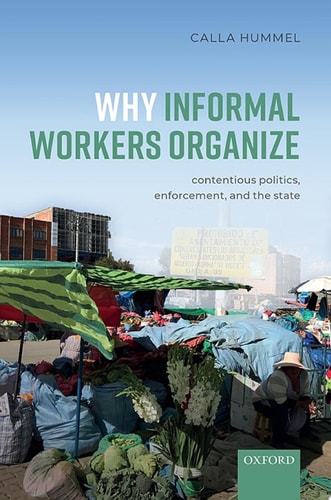
Informal workers make up over two billion workers or about 50% of the global workforce. Surprisingly, scholars know little about informal workers' political or civil society participation. An informal worker is anyone who holds a job and who does not pay taxes on taxable earnings, does not hold a license for their work when one is required, or is not part of a mandatory social security system. For decades, researchers argued that informal workers rarely organized or participated in civil society and politics. However, millions of informal workers around the world start and join unions. Why do informal workers organize? In countries like Bolivia, informal workers such as street vendors, fortune tellers, witches, clowns, gravestone cleaners, sex workers, domestic workers, and shoe shiners come together in powerful unions. In South Africa, South Korea, and India, national informal worker organizations represent millions of citizens. The data in this book finds that informal workers organize in nearly every country for which data exists, but to varying degrees. This raises a related question: Why do informal workers organize in some places more than others? The reality of informal work described in this book and supported by surveys in 60 countries, over 150 interviews with informal workers in Bolivia and Brazil, ethnographic data from multiple cities, and administrative data upends the conventional wisdom on the informal sector. The contrast between scholarly expectations and emerging data underpin the central argument of the book: Informal workers organize where state officials encourage them to.
Menrva's Summary
THE THESIS
This book investigates the conditions under which informal workers mobilize and form organizations, challenging the long-standing academic assumption that such workers remain politically inactive. Calla Hummel, a political scientist, utilizes a multi-method approach to analyze why informal workers organize in some regions more than others. By synthesizing global survey data with localized ethnographic research, the author argues that the primary driver of informal worker organization is the presence of state officials who actively encourage or facilitate such collective action.
THE SCOPE MAP
What You Will Find
- Comparative analysis of informal labor sectors across 60 countries.
- Qualitative data derived from over 150 interviews with workers in Bolivia and Brazil.
- Ethnographic observations from multiple urban centers.
- A theoretical framework linking state enforcement patterns to worker mobilization.
Scope Limits
- The study does not provide a comprehensive history of global labor unions.
- It does not offer specific policy prescriptions for individual national governments.
THE AUTHORITY PERSPECTIVE
Scholars in the fields of political economy and labor sociology recognize this work for its empirical rigor and its challenge to conventional wisdom regarding the informal sector. Experts highlight the book as a significant contribution to understanding the intersection of state policy and grassroots political participation.
Page Count:
225
Publication Date:
2021-01-01
Publisher:
OUP Oxford
ISBN-10:
0192663623
ISBN-13:
9780192663627
Economics
Labor Studies
Sociology
Public Policy
Community Tags
Similar Books