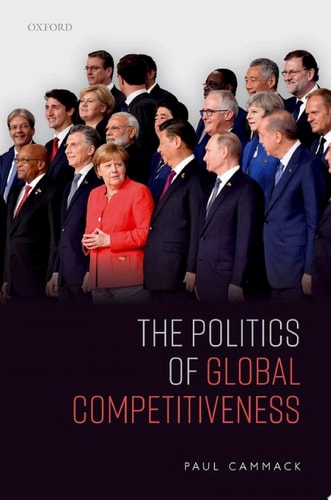
The Politics of Global Competitiveness
0
0
As an Amazon Associate and affiliate partner, Menrva Books earns from qualifying purchases. Learn more
Author Description
Marx predicted in Capital (1867) that as capitalism became global, patterns of work would be transformed, and workers would need to develop versatility, flexibility, and mobility. This 'general law of social production', as he called it, is now in evidence all around us, in global value chains, 'zero hours' contracts, and contract work organised through digital platforms. It results from competition between capitalists, scientific and technological revolutions in production, and incessant advances in the division of labour as production processes are broken down into ever smaller steps. This book documents the leading roles of the Paris-based Organisation for Economic Cooperation and Development and the Washington-based World Bank as advocates of these developments. They do not, as generally supposed, simply represent the interests of the advanced economies or the 'West' and their transnational corporations. They promote a single global model of capitalist development, without limits and on a genuinely global scale. It calls upon all states to 'adjust' continually to the structural and social demands of competitiveness, which they see as essential to the global hegemony of capital over labour. The OECD and the World Bank propose policies that give girls and women equal access to education and paid work, reform welfare to 'make work pay', introduce flexible labour contracts that make 'hiring and firing' easier, focus education on skills that boost employability, and draw workers in the developing world from the 'informal' sector into the formal sector, where they can be more productive. This is the politics of global competitiveness.
Menrva's Summary
THE THESIS
This book investigates how international organizations like the OECD and the World Bank actively promote a singular global model of capitalist development designed to prioritize the hegemony of capital over labor. Paul Cammack, a scholar of political economy, utilizes historical analysis and contemporary policy documentation to argue that these institutions function as architects of global labor transformation. He posits that the push for competitiveness is not merely an economic necessity but a deliberate political project that forces states to restructure their social and labor policies to suit the needs of global capital.
THE SCOPE MAP
What You Will Find
- Analysis of the OECD and World Bank as primary drivers of global labor policy.
- Examination of the 'general law of social production' as defined by Marx.
- Discussion of modern labor trends including digital platform work and zero-hours contracts.
- Critique of policies regarding welfare reform, education for employability, and the formalization of the informal sector.
Scope Limits
- The text focuses primarily on the institutional advocacy of the OECD and World Bank rather than the internal corporate strategies of individual transnational firms.
- It does not provide a comprehensive history of all global economic institutions, focusing specifically on those promoting the competitiveness agenda.
THE AUTHORITY PERSPECTIVE
Experts in political economy identify this work as a critical intervention in the study of global governance and neoliberal policy. Readers frequently note the academic density of the prose and the author's rigorous application of Marxist theory to contemporary institutional practices.
Page Count:
223
Publication Date:
2022-01-01
Publisher:
OUP Oxford
ISBN-10:
0192663704
ISBN-13:
9780192663702
Economics
Labor Studies
Globalization
International relations
Community Tags
Similar Books