Piranesi's Candelabra and the Presence of the Past: Excessive Objects and the Emergence of a Style in the Age of Neoclassicism
0
0
As an Amazon Associate and affiliate partner, Menrva Books earns from qualifying purchases. Learn more
Author Description
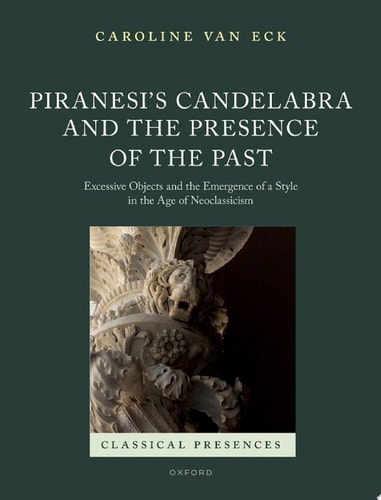
Near the end of his life, Giovanni Battista Piranesi (1720-78) created three colossal candelabra mainly from fragments of sculpture excavated near the Villa Hadriana in Tivoli, two of which are now in the Ashmolean Museum, and one in the Louvre. Although they were among the most sought-after and prestigious of his works, and fetched enormous prices during Piranesi's life, they suffered a steep decline in appreciation from the 1820s onwards, and even today they are among the least studied of his works. Piranesi's Candelabra and the Presence of the Past uncovers the intense investment, by artists, patrons, collectors, and the public around the start of the nineteenth century in objects that made Graeco-Roman Antiquity present again. Caroline van Eck's study examines how objects make their makers or viewers feel that they are again in the presence of Antiquity, that not only Antiquity has revived, but that classical statues become alive under their gaze. what it takes to make such objects, and what it costs to own them; and about the ramifications of such intense if not excessive attachments to artefacts. This book considers the three candelabra in depth, providing the biography of these objects, from the excavation of the Roman fragments to their entry into private and public collection. Van Eck considers the context that Piranesi gave them by including them in his Vasi, Candelabri e Cippi (1778), to rethink the processes that led to the development of neoclassicism from the perspective of the objects and objectscapes that came into being in Rome at the end of the eighteenth century.
Menrva's Summary
THE THESIS
This study investigates how Giovanni Battista Piranesi’s colossal candelabra functioned as agents of historical presence, bridging the gap between Graeco-Roman antiquity and the eighteenth-century viewer. Caroline van Eck, a scholar of art history and material culture, utilizes a methodology focused on object biography and the phenomenology of viewing. She argues that these composite artifacts were not merely decorative, but were central to the development of Neoclassicism by creating an intense, almost living connection to the classical past for their contemporary audience.
THE SCOPE MAP
What You Will Find
- Detailed provenance and biography of three specific colossal candelabra.
- Analysis of Piranesi’s publication 'Vasi, Candelabri e Cippi' (1778).
- Examination of the social and economic dynamics of the Roman art market in the late eighteenth century.
- Theoretical framework regarding the 'presence' of historical objects.
Scope Limits
- The study focuses primarily on the three specific candelabra mentioned rather than a comprehensive survey of all Piranesi’s works.
- It does not provide a general biography of Piranesi outside of his work on these specific objects.
THE AUTHORITY PERSPECTIVE
Scholars recognize this work as a significant contribution to the study of material culture and the reception of antiquity in the eighteenth century. Experts frequently highlight the author's ability to synthesize complex art historical theory with the physical history of specific artifacts.
Page Count:
220
Publication Date:
2023-01-01
Publisher:
OUP Oxford
ISBN-10:
0192660578
ISBN-13:
9780192660572
Archaeology
Art History
Humanities
Neoclassicism
European History
Community Tags
Similar Books