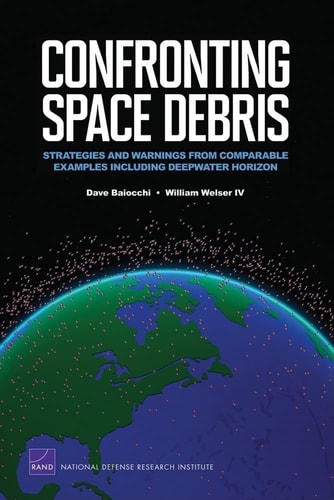
Confronting Space Debris: Strategies and Warnings from Comparable Examples Including Deepwater Horizon
0
0
As an Amazon Associate and affiliate partner, Menrva Books earns from qualifying purchases. Learn more
Author Description
Orbital (space) debris represents a growing threat to the operation of man-made objects in space. According to Nick Johnson, the National Aeronautics and Space Administration's (NASA's) chief scientist for orbital debris, '[T]he current orbital debris environment poses a real, albeit low level, threat to the operation of spacecraft' in both low earth orbit (LEO) and geosynchronous orbit (GEO) (Johnson, 2010). There are currently hundreds of thousands of objects greater than one centimeter in diameter in Earth's orbit. The collision of any one of these objects with an operational satellite would cause catastrophic failure of that satellite. This monograph presents a new way of thinking about the orbital debris problem. It should be of interest to space-faring nation-states and commercial firms, the legislative and executive branches of the U.S. government, the United Nations Committee on the Peaceful Uses of Outer Space, and the general public. This research was sponsored by the Defense Advanced Research Projects Agency (DARPA) and conducted within the Acquisition and Technology Policy Center of the RAND National Defense Research Institute, a federally funded research and development center sponsored by the Office of the Secretary of Defense, the Joint Staff, the Unified Combatant Commands, the Navy, the Marine Corps, the defense agencies, and the Intelligence Community.--Page iii.
Menrva's Summary
THE THESIS
The proliferation of orbital debris poses a significant and growing threat to the continued operation of vital space infrastructure. The monograph addresses the critical issue of space debris, which, despite currently posing a low-level threat, has the potential to cause catastrophic failure to operational satellites through collision with objects larger than one centimeter. It proposes a novel framework for understanding and mitigating this risk, drawing parallels with comparable incidents like the Deepwater Horizon disaster to inform strategies for space-faring entities, governmental bodies, and the public.
THE SCOPE MAP
- Analysis of the current orbital debris environment in Low Earth Orbit (LEO) and Geosynchronous Orbit (GEO).
- Assessment of the threat posed by hundreds of thousands of objects greater than one centimeter in diameter.
- Exploration of the potential for catastrophic satellite failure due to debris collision.
- Presentation of a new conceptual approach to addressing the orbital debris problem.
- Examination of comparable incidents, specifically referencing the Deepwater Horizon disaster for strategic insights.
- Identification of key stakeholders including space-faring nations, commercial firms, U.S. government branches, and international bodies.
- Discussion of research sponsored by the Defense Advanced Research Projects Agency (DARPA).
- Insights derived from work conducted within the RAND National Defense Research Institute.
THE AUTHORITY PERSPECTIVE
This work, sponsored by DARPA and conducted at the RAND Corporation, presents a novel approach to the pressing issue of orbital space debris. By drawing parallels with significant real-world incidents such as the Deepwater Horizon disaster, the authors aim to provide actionable strategies for space-faring nations and commercial entities. The research is positioned to inform policy decisions within governmental bodies and international organizations concerned with the peaceful use of outer space. The monograph's focus on a new way of thinking about the problem suggests an analytical and forward-looking perspective on a critical technological and environmental challenge.
Page Count:
127
Publication Date:
2010-01-01
Publisher:
Rand Corporation
ISBN-10:
0833050567
ISBN-13:
9780833050564
Non-Fiction
Science
Community Tags
Similar Books