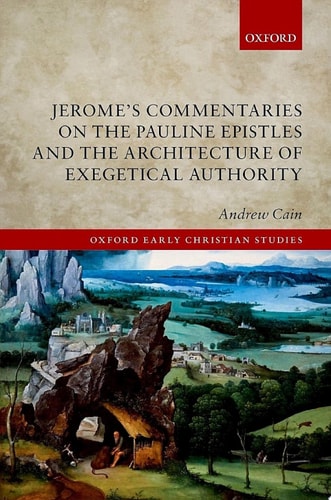
Jerome's Commentaries on the Pauline Epistles and the Architecture of Exegetical Authority
0
0
As an Amazon Associate and affiliate partner, Menrva Books earns from qualifying purchases. Learn more
Author Description
In the late fourth and early fifth centuries, during a fifty-year stretch sometimes dubbed a Pauline "renaissance" of the western church, six different authors produced over four dozen commentaries in Latin on Paul's epistles. Among them was Jerome, who commented on four epistles (Galatians, Ephesians, Titus, Philemon) in 386 after recently having relocated to Bethlehem from Rome. His commentaries occupy a time-honored place in the centuries-long tradition of Latin-language commenting on Paul's writings. They also constitute his first foray into the systematic exposition of whole biblical books (and his only experiment with Pauline interpretation on this scale), and so they provide precious insight into his intellectual development at a critical stage of his early career before he would go on to become the most prolific biblical scholar of Late Antiquity. This monograph provides the first book-length treatment of Jerome's opus Paulinum in any language. Adopting a cross-disciplinary approach, Cain comprehensively analyzes the commentaries' most salient aspects-from the inner workings of Jerome's philological method and engagement with his Greek exegetical sources, to his recruitment of Paul as an anachronistic surrogate for his own theological and ascetic special interests. One of the over-arching concerns of this book is to explore and to answer, from multiple vantage points, a question that was absolutely fundamental to Jerome in his fourth-century context: what are the sophisticated mechanisms by which he legitimized himself as a Pauline commentator, not only on his own terms but also vis-à-vis contemporary western commentators?
Menrva's Summary
THE THESIS
This monograph investigates the specific rhetorical and philological mechanisms Jerome employed to establish his authority as a commentator on the Pauline epistles within the competitive intellectual climate of the fourth-century western church. Andrew Cain, a scholar specializing in Late Antiquity, utilizes a cross-disciplinary framework to examine Jerome's commentaries on Galatians, Ephesians, Titus, and Philemon. By analyzing Jerome's engagement with Greek sources and his strategic use of Pauline theology to advance his own ascetic agenda, the author argues that these texts served as a critical foundation for Jerome's development into a preeminent biblical scholar.
THE SCOPE MAP
What You Will Find
- Analysis of Jerome's philological methods and source usage
- Examination of the fourth-century Pauline "renaissance" in the Latin church
- Investigation into the intersection of theological exposition and personal ascetic advocacy
- Contextualization of Jerome's work against contemporary western commentators
Scope Limits
- The study is restricted to Jerome's commentaries on four specific epistles
- The analysis does not cover Jerome's later, more mature biblical scholarship in its entirety
THE AUTHORITY PERSPECTIVE
Scholars recognize this work as the first comprehensive, book-length treatment of Jerome's Pauline commentaries in any language. Experts frequently highlight the text for its rigorous academic density and its significant contribution to the understanding of exegetical authority in Late Antiquity.
Page Count:
302
Publication Date:
2021-01-01
Publisher:
OUP Oxford
ISBN-10:
0192662910
ISBN-13:
9780192662910
History
Religion
Late Antiquity
Christianity
Bible
Theology