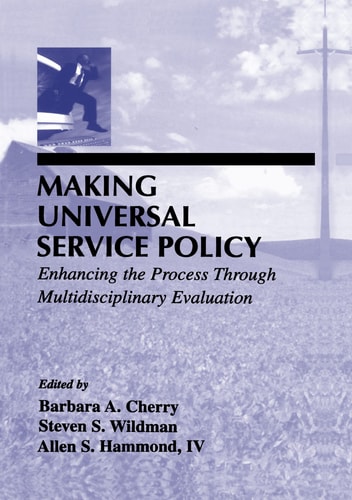
Making Universal Service Policy: Enhancing the Process Through Multidisciplinary Evaluation
0
0
As an Amazon Associate and affiliate partner, Menrva Books earns from qualifying purchases. Learn more
Author Description
This book is the outgrowth of shared interests between the editors and the contributing authors to provide a multidisciplinary perspective in evaluating universal service policy and recommending policy changes to accommodate a more competitive telecommunications environment. The book is interdisciplinary in nature to reflect the extremely complex context in which universal service policy is formed. The chapter authors represent a broad cross-section of disciplinary training, professional positions, and relationships in the telecommunications industry. Academic disciplines represented include law, economics, anthropology, communication, and business. This book's purpose is to significantly enhance the development of effective telecommunications universal service policy among policymakers, industry members, and stakeholders in the United States. Universal service policy has been, and will continue to be, both enabled and constrained by the simultaneous interaction of social, political, technological, and economic forces in the environment in which it is formed. A more effective process for policy design is to seek agreement on how entitlements embedded in universal service policy should be modified as circumstances invariably change over time. Therefore, the volume reflects recent significant developments in U.S. universal service policy--the implementation of which continues to unfold.
Menrva's Summary
THE THESIS
This book investigates how to improve the process of developing universal service policy in the telecommunications sector by employing a multidisciplinary evaluation approach. The editors and authors, drawn from law, economics, anthropology, communication, and business, aim to provide policymakers, industry members, and stakeholders with enhanced tools for creating effective policy in a rapidly evolving and competitive telecommunications environment. The work acknowledges that universal service policy is shaped by complex social, political, technological, and economic forces. It proposes that a more effective policy design process involves reaching agreement on how universal service entitlements should adapt to changing circumstances.
THE SCOPE MAP
- Analysis of universal service policy through the lenses of law, economics, anthropology, communication, and business.
- Recommendations for policy changes to accommodate a more competitive telecommunications landscape.
- Examination of the interplay between social, political, technological, and economic forces in policy formation.
- Discussion on achieving consensus regarding the modification of universal service entitlements over time.
THE AUTHORITY PERSPECTIVE
The book is presented as an outgrowth of shared interests among editors and authors to offer a multidisciplinary perspective on universal service policy evaluation. Its purpose is to enhance the development of effective telecommunications policy by integrating insights from various academic disciplines and professional backgrounds. The volume reflects recent significant developments in U.S. universal service policy, acknowledging the ongoing nature of its implementation.
Page Count:
280
Publication Date:
1999-08-01
Publisher:
Routledge
ISBN-10:
0805824561
ISBN-13:
9780805824568
Non-Fiction
Politics
Economics
Business
Telecommunications
Public Policy
Law
Community Tags
Similar Books