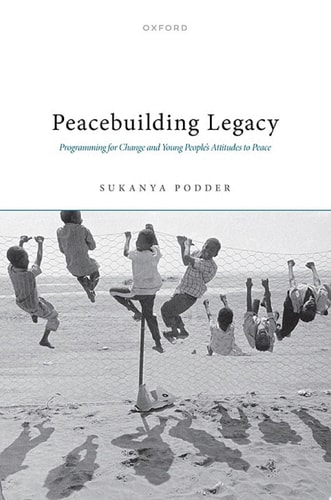
Peacebuilding Legacy: Programming for Change and Young People's Attitudes to Peace
0
0
As an Amazon Associate and affiliate partner, Menrva Books earns from qualifying purchases. Learn more
Author Description
A fundamental challenge plagues the global peacebuilding community. How can technocratic approaches to peacebuilding that are rooted in short-term, project-based execution of activities, further the longer-term transformative outcomes like altering young people's attitudes and beliefs about peace and violence? In response to this global challenge, in Peacebuilding Legacy, Sukanya Podder analyzes the long-term effects of peacebuilding programmes involving children and young people. Podder unpacks the concept of peacebuilding legacy through the lens of time, transformation, and intergenerational peace. Podder also develops unique qualitative cues for measuring legacy in terms of the institutional, normative, and organizational logics. If norms resonate strongly with the local context, they are likely to encourage strong retention and meaningful adoption over time. Successful institutionalization of project models through planned handover to successor national organizations, or government departments, holds the key to stronger local ownership. Organizational learning and reflection can support this process through a more strategic approach to programming, and through post-exit studies. Regarding attitude change, Podder found that, the media and peace education projects that targeted individuals' ingrained beliefs and values but overlooked the role of group social norms had only limited persuasive effects. To shift the values, practices, norms, and beliefs of the younger generation, the mindset of the older generation must also be targeted. Changes in the legal, political, economic, and other social institutions are critical for long-term and meaningful transformation. This requires adopting an ecological model of peace.
Menrva's Summary
THE THESIS
How can short-term, project-based peacebuilding interventions effectively foster long-term, transformative shifts in the attitudes and beliefs of young people regarding peace and violence? Sukanya Podder, a scholar specializing in conflict and peacebuilding, examines the efficacy of current programming by analyzing the concept of 'peacebuilding legacy' through the dimensions of time, institutionalization, and intergenerational influence. She argues that lasting change requires moving beyond technocratic models toward an ecological approach that addresses both individual beliefs and the broader social norms of the older generation.
THE SCOPE MAP
What You Will Find
- A framework for measuring peacebuilding legacy through institutional, normative, and organizational logics.
- Analysis of the role of media and peace education projects in shaping youth attitudes.
- An ecological model for peace that integrates legal, political, and economic institutional reform.
Scope Limits
- The text does not provide a universal manual for every specific conflict zone.
- It does not focus on immediate tactical conflict resolution but rather on long-term longitudinal outcomes.
THE AUTHORITY PERSPECTIVE
Experts identify this work as a significant contribution to the study of peacebuilding sustainability and institutional memory. Readers frequently note the academic density of the prose, which serves as a rigorous resource for practitioners and researchers interested in the long-term impact of international development programs.
Page Count:
520
Publication Date:
2022-01-01
Publisher:
OUP Oxford
ISBN-10:
0192678892
ISBN-13:
9780192678898
Sociology
Peace studies
Youth development
Conflict Resolution
International relations
Community Tags
Similar Books