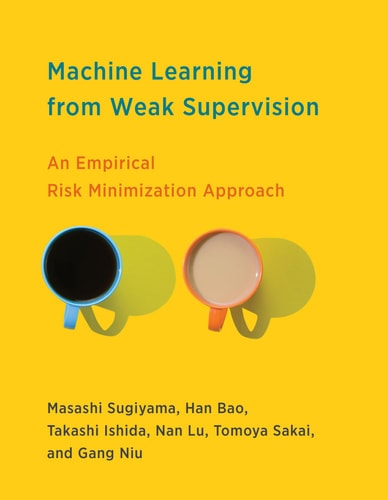
Machine Learning from Weak Supervision: An Empirical Risk Minimization Approach
0
0
As an Amazon Associate and affiliate partner, Menrva Books earns from qualifying purchases. Learn more
Author Description
Fundamental theory and practical algorithms of weakly supervised classification, emphasizing an approach based on empirical risk minimization. Standard machine learning techniques require large amounts of labeled data to work well. When we apply machine learning to problems in the physical world, however, it is extremely difficult to collect such quantities of labeled data. In this book Masashi Sugiyama, Han Bao, Takashi Ishida, Nan Lu, Tomoya Sakai and Gang Niu present theory and algorithms for weakly supervised learning, a paradigm of machine learning from weakly labeled data. Emphasizing an approach based on empirical risk minimization and drawing on state-of-the-art research in weakly supervised learning, the book provides both the fundamentals of the field and the advanced mathematical theories underlying them. It can be used as a reference for practitioners and researchers and in the classroom. The book first mathematically formulates classification problems, defines common notations, and reviews various algorithms for supervised binary and multiclass classification. It then explores problems of binary weakly supervised classification, including positive-unlabeled (PU) classification, positive-negative-unlabeled (PNU) classification, and unlabeled-unlabeled (UU) classification. It then turns to multiclass classification, discussing complementary-label (CL) classification and partial-label (PL) classification. Finally, the book addresses more advanced issues, including a family of correction methods to improve the generalization performance of weakly supervised learning and the problem of class-prior estimation.
Menrva's Summary
THE THESIS
This book investigates the fundamental theory and practical algorithms of weakly supervised classification, focusing on an empirical risk minimization approach. The authors, leading researchers in the field, address the challenge of applying machine learning when large amounts of labeled data are difficult to collect. They provide a comprehensive overview, starting with the mathematical formulation of classification problems and common notations, before delving into specific weakly supervised scenarios. The work aims to equip practitioners and researchers with both the foundational knowledge and advanced mathematical understanding necessary for this specialized area of machine learning.
THE SCOPE MAP
- Mathematical formulation of classification problems and common notations.
- Algorithms for supervised binary and multiclass classification.
- Exploration of binary weakly supervised classification: PU, PNU, and UU classification.
- Discussion of multiclass weakly supervised classification: CL and PL classification.
- Advanced issues including correction methods for generalization performance.
- The problem of class-prior estimation.
THE AUTHORITY PERSPECTIVE
This book is positioned as a foundational text for both practitioners and researchers in the field of weakly supervised learning. Its emphasis on empirical risk minimization provides a theoretical backbone for understanding advanced algorithms. The structured approach, moving from basic concepts to complex multiclass problems and advanced techniques, suggests it is intended as a comprehensive reference and a classroom resource. The inclusion of specific classification types like PU, PNU, CL, and PL indicates a focus on practical, albeit challenging, real-world machine learning scenarios.
Page Count:
320
Publication Date:
2022-08-23
Publisher:
MIT Press
ISBN-10:
0262047071
ISBN-13:
9780262047074
Science
Non-Fiction
Machine Learning
Data Science
Computer Science
Community Tags
Similar Books