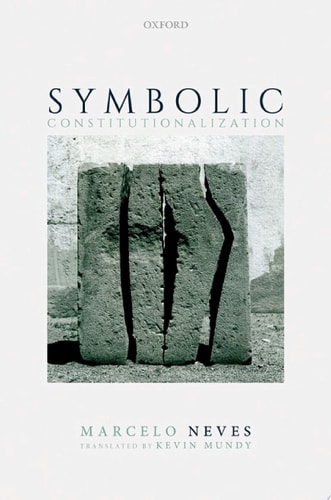
Symbolic Constitutionalization
0
0
As an Amazon Associate and affiliate partner, Menrva Books earns from qualifying purchases. Learn more
Author Description
The subject of this book is the social and political meaning of constitutional texts to the detriment of their legal concretization. Focusing on the discrepancy between the hypertrophically symbolic function of constitutions and their insufficient legal concretization, it offers a critical counterpoint to constitutional theory that treats constitutional texts as a panacea to solving political, legal, and social problems. In contrast to the premises of Niklas Luhmann's systems theory regarding law and constitution in world's society, symbolic constitutionalization is approached here in both a comprehensive and far-reaching perspective. Chapter 1 sets out the debate about symbolic legislation. Chapter 2 explains the notion of symbolic constitutionalization as a problem embracing the whole legal system. Chapter 3 approaches the issue in terms of allopoiesis of law, characterizing it primarily as a problem in peripheral modernity and referring to the Brazilian experience. The final chapter discusses the tendency to a symbolic constitutionalization of world society in the scope of a paradoxical peripheralization of the centre.
Menrva's Summary
THE THESIS
This book investigates the social and political implications of constitutional texts that function symbolically while failing to achieve actual legal concretization. Marcelo Neves, a prominent legal scholar, utilizes systems theory to analyze the gap between the high symbolic value placed on constitutions and their limited practical application. By critiquing the view of constitutions as universal solutions, the author provides a framework for understanding how legal systems operate within the context of peripheral modernity.
THE SCOPE MAP
What You Will Find
- Analysis of symbolic legislation and its impact on the broader legal system
- Application of Niklas Luhmann's systems theory to constitutional studies
- Examination of the allopoiesis of law in peripheral societies
- Case studies focusing on the Brazilian legal experience
Scope Limits
- The text does not provide a manual for drafting effective constitutional documents
- It does not offer a comprehensive history of global constitutional law
THE AUTHORITY PERSPECTIVE
Legal scholars frequently cite this work as a critical contribution to the sociology of law, particularly regarding the challenges of constitutionalism in developing nations. Readers often note the academic density of the prose, which requires a strong background in systems theory to fully grasp the author's arguments.
Page Count:
190
Publication Date:
2022-01-01
Publisher:
OUP Oxford
ISBN-10:
0192671375
ISBN-13:
9780192671370
Legal Theory
Constitutional Law
Law
Professional Career & Trade
Sociology of Law
Community Tags
Similar Books