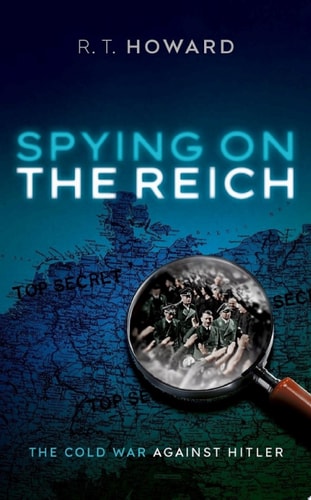
Spying on the Reich: The Cold War Against Hitler
0
0
As an Amazon Associate and affiliate partner, Menrva Books earns from qualifying purchases. Learn more
Author Description
Exactly a century ago, intelligence agencies across Europe first became aware of a fanatical German nationalist whose political party was rapidly gathering momentum. His name was Adolf Hitler. From 1933, these spy services watched with growing alarm as they tried to determine what sort of threat Hitler's regime would now pose to the rest of Europe. Would Germany rearm, either covertly or in open defiance of the outside world? Would Hitler turn his attention eastwards - or did he also pose a threat to the west? What were the feelings and attitudes of ordinary Germans, towards their own regime as well as the outside world? Despite intense rivalry and mistrust between them, these spy chiefs began to liaise and close ranks against Nazi Germany. At the heart of this loose, informal network were the British and French intelligence services, alongside the Poles and Czechs. Some other countries - Holland, Belgium, and the United States - stood at the periphery. Drawing on a wide range of previously unpublished British, French, German, Danish, and Czech archival sources, Spying on the Reich tells the story of Germany and its rearmament in the 1920s and 1930s; its relations with foreign governments and their intelligence services; and the relations and rivalries between Western governments, seen through the prism of the cooperation, or lack of it, between their spy agencies. Along the way, it addresses some of the most intriguing questions that still perplex historians of the period, such as how and why Britain defended Poland in September 1939, and what alternative policies could have been pursued?
Menrva's Summary
THE THESIS
This book investigates how international intelligence agencies collaborated and competed to monitor the rise of Nazi Germany and its rearmament efforts during the interwar period. R. T. Howard, a historian specializing in intelligence and military affairs, utilizes a vast array of previously unpublished archival materials from across Europe. The work argues that the informal network of spy services, particularly between Britain, France, Poland, and Czechoslovakia, provided the critical, albeit often ignored, intelligence that shaped Western diplomatic and military responses to Hitler's regime.
THE SCOPE MAP
What You Will Find
- Analysis of intelligence gathering on German rearmament from 1933 to 1939.
- Examination of the informal cooperation between British, French, Polish, and Czech intelligence services.
- Investigation into the geopolitical motivations behind the defense of Poland in 1939.
- Use of primary source documents from British, French, German, Danish, and Czech archives.
Scope Limits
- The book focuses primarily on European intelligence networks and does not provide an exhaustive account of global espionage operations.
- It does not cover the entirety of the Second World War, concluding its primary analysis at the outbreak of hostilities in 1939.
THE AUTHORITY PERSPECTIVE
Historians and reviewers frequently note the high level of archival detail and the author's ability to synthesize complex intelligence reports into a coherent narrative. Experts highlight this as a significant contribution to understanding the pre-war diplomatic landscape through the lens of clandestine operations.
Page Count:
372
Publication Date:
2022-01-01
Publisher:
OUP Oxford
ISBN-10:
0192677608
ISBN-13:
9780192677600
History
World War
Intelligence
Espionage
Military History
Modern History
European History
Community Tags
Similar Books