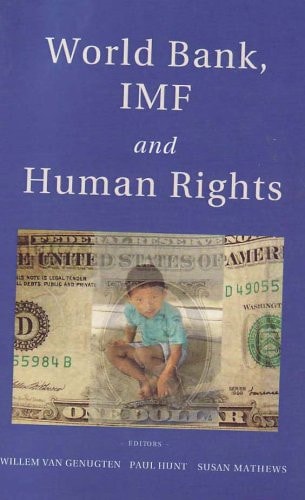
World Bank, IMF and Human Rights Including the Tilburg Guiding Principles on World Bank, IMF and Human Rights
0
0
As an Amazon Associate and affiliate partner, Menrva Books earns from qualifying purchases. Learn more
Author Description
At the end of the second world war the United Nations re-invented the human rights and this led to the adoption of many human rights instruments. The question is to what extent international organizations like the World Bank and the IMF are bound to live up to these human rights obligations. Alfredo Sfeir-Younis states in the first chapter that economists, economics and economic institutions will open up their doors to the human rights-based model when the strength of a political consensus is such that the foundations of values will also change. Mainstreaming human rights into economic development is not a matter of economics but of political economy.This book discusses the legal status of the World Bank and the IMF, in relation to human rights obligations and to issues in the political and economic field closely related to that.
Menrva's Summary
THE THESIS
This book investigates the extent to which international financial institutions like the World Bank and the IMF are bound by human rights obligations established post-World War II. Alfredo Sfeir-Younis posits that a shift towards a human rights-based model within economic institutions hinges on the strength of political consensus and evolving values, framing the mainstreaming of human rights into economic development as a matter of political economy rather than pure economics. The work examines the legal standing of the World Bank and IMF concerning their human rights duties and related political and economic issues.
THE SCOPE MAP
- Analysis of the legal status of the World Bank and IMF in relation to human rights obligations.
- Discussion on the political economy of integrating human rights into economic development.
- Examination of the conditions under which economic institutions might adopt a human rights-based model.
- Inclusion of the Tilburg Guiding Principles on World Bank, IMF and Human Rights.
THE AUTHORITY PERSPECTIVE
The book addresses a critical intersection of international finance and human rights, likely appealing to scholars, policymakers, and advocates in both fields. Its focus on the legal and political-economic dimensions suggests a rigorous academic approach. The inclusion of the Tilburg Guiding Principles indicates a practical aim to inform and potentially shape institutional practice. The work appears to be a foundational text for understanding the accountability of global financial institutions to human rights standards.
Page Count:
257
Publication Date:
2003-01-01
Publisher:
Wolf Legal Publishers
ISBN-10:
9058500535
ISBN-13:
9789058500533
Economics
Politics
Non-Fiction
International Law
Human rights
Community Tags
Similar Books