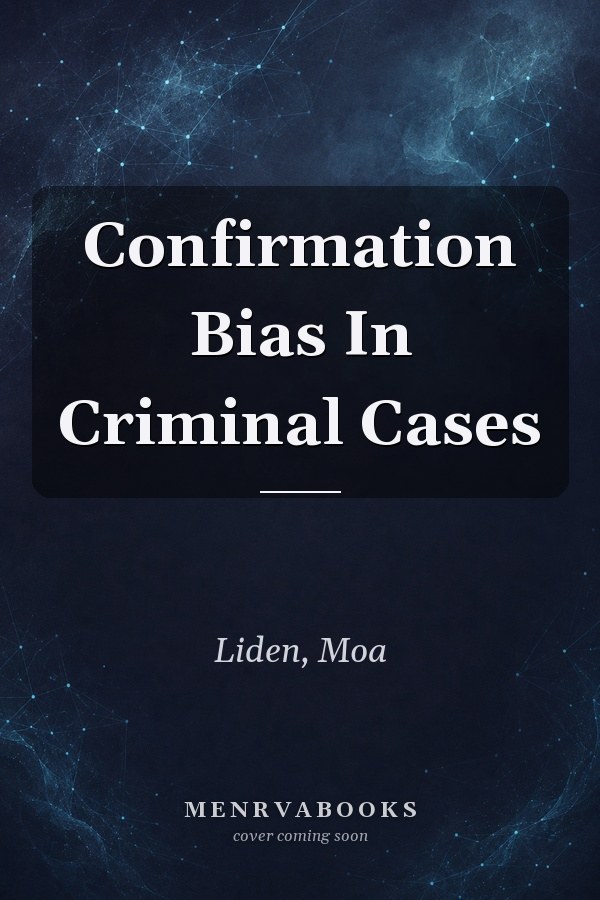
Confirmation Bias In Criminal Cases
0
0
As an Amazon Associate and affiliate partner, Menrva Books earns from qualifying purchases. Learn more
Author Description
Confirmation Bias Is A Tendency To Selectively Search For And Emphasize Information That Is Consistent With A Hypothesis Or Preferred Conclusion. At The Same Time, Opposing Information Is Ignored Or Interpreted In Ways That Do Not Threaten The Predetermined Conclusion. Importantly, Confirmation Bias Is A More Or Less Subconscious Phenomenon. Hence, Legal Actors And Criminal Practitioners Who Are Expected To Be Objective, Who May Make Genuine Efforts To Be Objective And Who Also Perceive Of Themselves As Objective, May Still Display A Confirmation Bias. This Includes Police Officers, Crime Scene Investigators, Forensic Analysts, Pathologists, Prosecutors And Judges And The Range Of Distinct Decision Making Tasks That These Actors Have, For Example, Interviews With Suspects, Witness, Plaintiff, Crime Scene Investigations, Autopsies, Decisions About Whether To Press Charges And Whether To Convict. Since Confirmation Bias Can Be Present At All Stages Of Criminal Investigations And Proceedings, It Constitutes A Serious Risk Of Error, For Example, Wrongful Convictions And Wrongful Acquittals. It Is Therefore Essential To Find And Use Bias Mitigation Measures, And A Good Starting Point Is The Explanations Of This Bias Provided In Cognitive, Motivation And Emotion, Social And Organizational Psychology. This Includes Measures Such As Changing Decision Maker, Contextual Information Management, Linear Sequential Unmasking And Structured Evaluations Of The Evidence
Menrva's Summary
THE THESIS
This book investigates how confirmation bias functions as a cognitive mechanism that compromises the objectivity of legal actors within the criminal justice system. Author Moa Lidén, an expert in legal psychology, synthesizes research from cognitive, motivational, and organizational psychology to explain why even well-intentioned professionals—including police, forensic analysts, and judges—frequently fall prey to biased decision-making. The text argues that because this bias operates subconsciously, systemic mitigation strategies are required to prevent wrongful convictions and miscarriages of justice.
THE SCOPE MAP
What You Will Find
- Analysis of cognitive, motivational, and emotional drivers of bias in legal settings
- Examination of specific roles including crime scene investigators, prosecutors, and judges
- Evaluation of mitigation techniques such as linear sequential unmasking and contextual information management
- Theoretical frameworks derived from social and organizational psychology
Scope Limits
- The text does not provide a comprehensive legal manual for courtroom procedure
- It does not cover the historical evolution of criminal law beyond the context of cognitive bias
THE AUTHORITY PERSPECTIVE
Experts identify this work as a critical interdisciplinary resource for legal practitioners and researchers interested in the intersection of psychology and criminal procedure. Readers frequently note the academic rigor of the prose, which effectively bridges the gap between psychological theory and practical application in the courtroom.
Page Count:
0
Publication Date:
2023-01-01
ISBN-10:
0192693433
ISBN-13:
9780192693433
Psychology
Decision Making
Forensic Science
Law
Community Tags
Similar Books