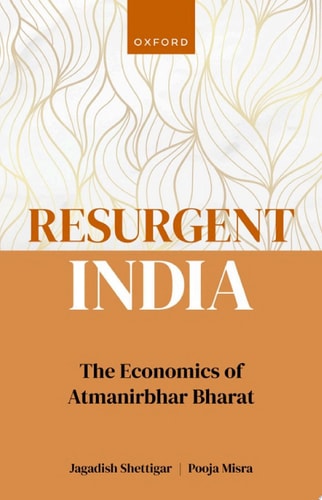
Resurgent India: The Economics of Atmanirbhar Bharat
0
0
As an Amazon Associate and affiliate partner, Menrva Books earns from qualifying purchases. Learn more
Author Description
In the backdrop of the Coronavirus having wreaked havoc on nations across the world and adversely impacting economic growth of countries, the government and monetary authorities,such as the Reserve Bank of India, stepped forward with conventional as well as unconventional stimulus measures. This was the time for the Government and fellow Indians to reboot, redraw, and reinvent the wheel of progress, and paint a new standing in the World Economic Order. Thus, in light of the above-mentioned macroeconomic scenario existing in India in June 2020, the authors decided to continuously examine the important measures and policies announced by the Government and evaluate its impact on the country. Part 1 of the book traces the preceding trends in the economic growth of the country during 2010-20, the initial impact of the virus on the Indian economy, the macroeconomic perspectives, including the required fiscal measures through the very first post-pandemic budget, i.e., for 2021-22, and the country's progress on the path to economic recovery in the first quarter of 2022. Part 2 critically analyses policy initiatives undertaken by the Government for achieving an Atmanirbhar Bharat (self-reliant India), short-term and long-term structural reforms, agricultural reforms, the six pillars on which the union budget 2021-22 has been formulated, and bold measures like the proposal for asset monetization of PSUs and government's re-think on retrospective taxes. Part 3 lays out a roadmap of policy suggestions which warrant government focus and attention to make India into a self-reliant nation. These initiatives can help in achieving the dream of doubling farmers' income and making India into a global manufacturing hub. This section also discusses the importance of cooperative federalism and challenges before the government in making India into a self-reliant nation, especially in terms of administrative machinery and the judicial system.
Menrva's Summary
THE THESIS
This book investigates the economic viability and strategic implementation of the Atmanirbhar Bharat (self-reliant India) initiative in the wake of the global COVID-19 pandemic. The authors, Jagadish Shettigar and Pooja Misra, utilize macroeconomic data and policy analysis to evaluate the government's stimulus measures and structural reforms introduced between 2020 and 2022. They argue that a combination of fiscal discipline, agricultural reform, and administrative restructuring is necessary to transition India into a global manufacturing hub.
THE SCOPE MAP
What You Will Find
- Analysis of Indian economic trends from 2010 to 2020.
- Evaluation of the 2021-22 Union Budget and its six pillars.
- Examination of structural reforms including asset monetization and retrospective tax policy.
- A proposed roadmap for achieving self-reliance through cooperative federalism.
Scope Limits
- The analysis is primarily focused on the immediate post-pandemic period and may not account for long-term global geopolitical shifts occurring after 2022.
- The text does not provide a comprehensive history of Indian economic policy prior to 2010.
THE AUTHORITY PERSPECTIVE
Experts and policy analysts view this work as a detailed examination of the specific fiscal and structural interventions undertaken by the Indian government during a period of significant economic volatility. Readers frequently note the technical density of the prose, making it a useful resource for students of public policy and those interested in the mechanics of Indian economic reform.
Page Count:
249
Publication Date:
2022-01-01
Publisher:
OUP Oxford
ISBN-10:
0192691600
ISBN-13:
9780192691606
Economics
Economic History
Principles of Macroeconomics
Indian Politics
Macroeconomics
Public Policy
Community Tags
Similar Books