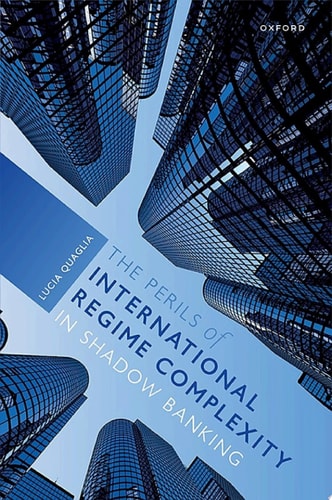
The Perils of International Regime Complexity in Shadow Banking
0
0
As an Amazon Associate and affiliate partner, Menrva Books earns from qualifying purchases. Learn more
Author Description
Despite the role of shadow banking in the building up of the 2008 international financial crisis, the massive size of this sector, its cross-border nature, and the risks it entails for financial stability, the post-crisis regulation of shadow banking has remained rather feeble. Why? The Perils of International Regime Complexity in Shadow Banking identifies a 'game of shadows', which unfolded recursively concerning the definition, monitoring, and regulation of shadow banking internationally. Thus, states, regulators, and private actors tended to cast light away from various parts of the shadow banking system - shadow banking was (re)fined over time, its measurement was narrowed down, lessening the (perceived) need for regulation. The playing out of such a game was facilitated by the international architecture for shadow banking governance, which is a 'regime complex' characterized by the presence of multiple institutions and elemental regimes governing a set of related issues. Indeed, shadow banking is a quintessential case for demonstrating the perils of international regime complexity, which magnifies problems that are endemic in governing global finance - namely, interstate competition, disagreement between technocratic bodies, and the power of the financial industry - while splintering solutions, due to the fragmentation of regulatory authority. Empirically, this book examines various elemental regimes concerning different aspects of shadow banking, namely: international standards for defining, measuring, and monitoring global shadow banking; international standards for shadow banking entities, including money market funds, hedge funds, and investment funds; international standards for shadow banking activities, such as securitization, securities lending, and repos; international standards for bank capital exposures to shadow banking.
Menrva's Summary
THE THESIS
This book investigates why post-crisis regulation of the shadow banking sector has remained ineffective despite the system's significant role in the 2008 international financial crisis. Lucia Quaglia, a scholar of international political economy, utilizes a framework of 'regime complexity' to argue that the fragmented nature of global governance allows states, regulators, and private actors to strategically narrow the definition and monitoring of shadow banking. By analyzing the interplay between interstate competition, technocratic disagreement, and industry influence, the author demonstrates how this complexity systematically undermines robust regulatory oversight.
THE SCOPE MAP
What You Will Find
- Analysis of the 'game of shadows' regarding the definition and measurement of shadow banking.
- Examination of international standards for money market funds, hedge funds, and investment funds.
- Evaluation of regulatory standards for securitization, securities lending, and repos.
- Assessment of bank capital exposure standards related to shadow banking.
Scope Limits
- The text focuses primarily on international governance structures rather than domestic-level implementation in specific non-G20 nations.
- It does not provide a comprehensive history of shadow banking prior to the 2008 financial crisis.
THE AUTHORITY PERSPECTIVE
Experts identify this work as a significant contribution to the study of global financial governance and the limitations of institutional fragmentation. Readers frequently note the academic density of the prose, which is well-suited for researchers and policymakers interested in the intersection of international relations and financial stability.
Page Count:
344
Publication Date:
2022-01-01
Publisher:
OUP Oxford
ISBN-10:
0192691708
ISBN-13:
9780192691705
Economics
International relations
Finance
Public Policy
Community Tags
Other Editions(2)

Similar Books




Reader Comments
Share Your Thoughts
No comments yet. Be the first to share your thoughts!