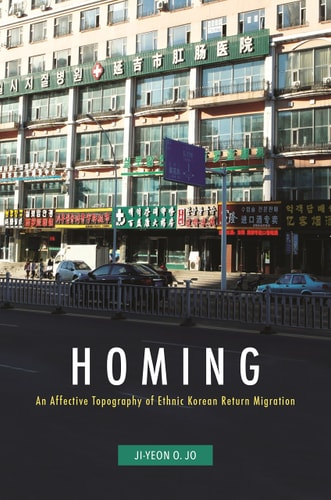
Homing: An Affective Topography of Ethnic Korean Return Migration
0
0
As an Amazon Associate and affiliate partner, Menrva Books earns from qualifying purchases. Learn more
Author Description
Millions of ethnic Koreans have been driven from the Korean Peninsula over the course of the region’s modern history. Emigration was often the personal choice of migrants hoping to escape economic and political hardship, but it was also enforced or encouraged by governmental relocation and migration projects in both colonial and postcolonial times. The turning point in South Korea’s overall migration trajectory occurred in the late 1980s and early 1990s, when the nation’s increased economic prosperity and global visibility, along with shifting geopolitical relationships between the First World and Second World, precipitated a migration flow to South Korea. Since the early 1990s, South Korea’s foreign-resident population has soared more than 3,000 percent. Homing investigates the experiences of legacy migrants—later-generation diaspora Koreans who “return” to South Korea—from China, the Commonwealth of Independent States, and the United States. Unlike their parents or grandparents, they have no firsthand experience of their ancestral homeland. They inherited an imagined homeland through memories, stories, pictures, and traditions passed down by family and community, or through images disseminated by the media. When diaspora Koreans migrate to South Korea, they confront far more than a new living situation: they must navigate their own shifting emotions as their expectations for their new homeland—and its expectations of them—confront reality. Everyday experiences and social encounters—whether welcoming or humiliating—all contribute to their sense of belonging in the South. Homing addresses some of the most vexing and pressing issues of contemporary transnational migration—citizenship, cultural belonging, language, and family relationships—and highlights their affective dimensions. Using accounts gleaned through interviews, author Ji-Yeon Jo situates migrant experiences within the historical context of each diaspora. Her book is the firs
Menrva's Summary
THE THESIS
This book investigates the complex emotional and social experiences of ethnic Korean 'return migrants' who relocate to South Korea from various diasporic communities. The author, Ji-Yeon Jo, examines how individuals, particularly those from China, the Commonwealth of Independent States, and the United States, navigate their identities and sense of belonging when confronting a homeland they only know through inherited memories and media portrayals. The book explores the challenges of reconciling imagined homelands with lived realities, focusing on the affective dimensions of citizenship, cultural integration, language, and family relationships.
THE SCOPE MAP
- Analysis of 'legacy migrants'—later-generation diaspora Koreans returning to South Korea.
- Exploration of imagined homelands constructed through family memories, stories, and media.
- Examination of the affective dimensions of migration, including emotions and sense of belonging.
- Discussion of contemporary transnational migration issues: citizenship, cultural belonging, language, and family.
- Integration of migrant experiences within the historical context of their respective diasporas.
- Use of interview accounts to situate individual migrant narratives.
THE AUTHORITY PERSPECTIVE
The book is positioned as a significant contribution to the study of contemporary transnational migration, particularly focusing on the under-researched experiences of second and third-generation diaspora Koreans. Its strength lies in its detailed ethnographic approach, using interviews to capture the nuanced emotional landscapes of return migrants. The work highlights the intersection of personal identity, historical context, and the affective realities of navigating a homeland that is both ancestral and foreign. It addresses pressing issues of belonging and citizenship within the context of South Korea's evolving demographic and global position.
Page Count:
264
Publication Date:
2022-03-31
Publisher:
University of Hawaii Press
ISBN-10:
0824867769
ISBN-13:
9780824867768
Autobiography
History
Non-Fiction
Affect Studies
Cultural Anthropology
Transnationalism
Migration Studies
Sociology
Community Tags
Other Editions(3)

Similar Books








Reader Comments
Share Your Thoughts
No comments yet. Be the first to share your thoughts!