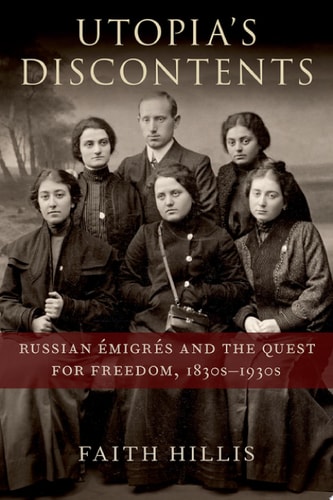
Utopia's Discontents: Russian Émigrés and the Quest for Freedom, 1830s-1930s
0
0
As an Amazon Associate and affiliate partner, Menrva Books earns from qualifying purchases. Learn more
Author Description
In April 1917, Lenin arrived at Petrograd's Finland Station and set foot on Russian soil for the first time in over a decade. For most of the past seventeen years, the Bolshevik leader had lived in exile, moving between Europe's many "Russian colonies"--large and politically active communities of émigrés in London, Paris, and Geneva, among other cities. Thousands of fellow exiles who followed Lenin on his eastward trek in 1917 were in a similar predicament. The returnees plunged themselves into politics, competing to shape the future of a vast country recently liberated from tsarist rule. Yet these activists had been absent from their homeland for so long that their ideas reflected the Russia imagined by residents of the faraway colonies as much as they did events on the ground. The 1917 revolution marked the dawn of a new day in Russian politics, but it also represented the continuation of decades-long conversations that had begun in emigration and were exported back to Russia.Faith Hillis examines how émigré communities evolved into revolutionary social experiments in the heart of bourgeois cities. Feminists, nationalist activists, and Jewish intellectuals seeking to liberate and uplift populations oppressed by the tsarist regime treated the colonies as utopian communities, creating new networks, institutions, and cultural practices that reflected their values and realized the ideal world of the future in the present. The colonies also influenced their European host societies, informing international debates about the meaning of freedom on both the left and the right. Émigrés' efforts to transform the world played crucial roles in the articulation of socialism, liberalism, anarchism, and Zionism across borders. But they also produced unexpected--and explosive--discontents that defined the course of twentieth-century history.This groundbreaking transnational work demonstrates the indelible marks the Russian colonies left on European politics, legal cultures, and so
Menrva's Summary
THE THESIS
How did the transnational communities of Russian émigrés between the 1830s and 1930s shape the political ideologies and revolutionary movements that defined the twentieth century? Faith Hillis, a historian specializing in modern Russian history, utilizes extensive archival research from European cities to argue that these 'Russian colonies' functioned as laboratories for political experimentation. She posits that the ideas and institutional structures developed by exiles in cities like London, Paris, and Geneva were not merely reactions to home-country politics but were proactive, utopian social models that influenced both the Russian Revolution and broader European political discourse.
THE SCOPE MAP
What You Will Find
- Analysis of the social and institutional structures within Russian émigré colonies in major European cities.
- Examination of how diverse groups, including feminists, nationalists, and Jewish intellectuals, utilized exile to develop political frameworks.
- Exploration of the cross-pollination between Russian revolutionary thought and European liberal, socialist, and Zionist movements.
Scope Limits
- The study focuses primarily on the political and social activities of the émigré colonies rather than a comprehensive military or diplomatic history of the Russian state.
- The narrative concludes in the 1930s, leaving the later developments of the Cold War era outside the primary scope of this analysis.
THE AUTHORITY PERSPECTIVE
Scholars and historians recognize this work as a significant contribution to the study of transnational political movements and the history of the Russian diaspora. Readers frequently note the academic rigor of the prose and the depth of the archival evidence provided to support the author's claims.
Page Count:
360
Publication Date:
2021-04-30
Publisher:
Oxford University Press
ISBN-10:
0190066334
ISBN-13:
9780190066338
History
Politics
Anthropology
Russian History
New Used & Rental Textbooks
Europe
Sociology
World
Cultural
Migration Studies
European History
Military
Revolutionary
Social History
Judaism
Community Tags
Other Editions(2)
Similar Books



Reader Comments
Share Your Thoughts
No comments yet. Be the first to share your thoughts!