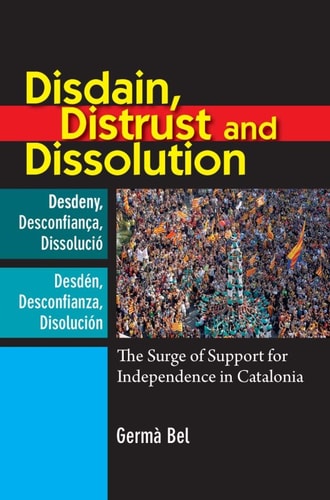
Disdain, Distrust and Dissolution: The Surge of Support for Independence in Catalonia
0
0
As an Amazon Associate and affiliate partner, Menrva Books earns from qualifying purchases. Learn more
Author Description
Support for independence in Catalonia has increased rapidly over the past decade. This dynamic is the result of Catalans in political, economic and academic fields who no longer believe that the necessary reform of Spanish government is a viable option in terms of achieving an acceptable arrangement for Catalonia to stay within the Spanish state. Rejecting assimilation on the basis that a uni-national state is unworkable for a host of structural reasons, not least the lack of reform progress to date, secession is viewed as the preferred choice for the betterment of the region's people. This book dissects the problems of the relationship between Catalonia and Spain. The author investigates the dynamics of conflict between opposing groups, the resulting effects on inter-territorial distrust, and the impact on the functioning of the Spanish state as a whole. These conflictual issues are projected onto areas of public policy that reflect basic motivations of rising public support for independence: national identity and sense of community (language and education policy); economic viability (fiscal relations with the state); and future opportunities in a global world (issues of infrastructure, especially transport). The overwhelming conclusion is that the accumulation of mutual distrust between the opposing parties is a major obstacle to the functioning of the Spanish state. Mutual perception of unfairness and lack of trust is an impediment to the design and functioning of future shared projects -- and without agreement and engagement there is no benefit to either party, to the detriment of Spain and its peoples. Published in association with the Canada Blanch Centre for Contemporary Spanish Studies/Catalan Observatory.
Menrva's Summary
THE THESIS
The book investigates the escalating support for Catalan independence and the deep-seated distrust between Catalonia and the Spanish state. The author, Germà Bel, examines how political, economic, and academic elites in Catalonia have lost faith in the possibility of reforming the Spanish government to accommodate regional needs. This has led to secession being viewed as the most viable path forward, driven by a rejection of assimilation and the structural failures of the Spanish state. The analysis dissects the core issues fueling this movement, including national identity, fiscal relations, and future opportunities, highlighting how mutual distrust impedes progress and shared projects.
THE SCOPE MAP
- Analysis of the political, economic, and academic factors driving Catalan independence sentiment.
- Examination of the historical relationship and conflict dynamics between Catalonia and Spain.
- Investigation into the impact of inter-territorial distrust on the functioning of the Spanish state.
- Discussion of public policy areas reflecting motivations for independence: national identity, language, education, fiscal relations, and infrastructure.
- Conclusion on the significant role of mutual distrust as an obstacle to shared projects and state functionality.
THE AUTHORITY PERSPECTIVE
The book is presented as a rigorous analysis of the complex relationship between Catalonia and Spain, focusing on the roots of the independence movement. It dissects the structural issues and the accumulation of distrust that have led to secession becoming a prominent political choice. The author's examination of public policy areas such as identity, economics, and infrastructure provides a comprehensive view of the conflict's drivers. The work concludes that this pervasive distrust is a fundamental impediment to the Spanish state's ability to foster agreement and shared progress.
Page Count:
224
Publication Date:
2015-01-01
Publisher:
Sussex Academic Press
ISBN-10:
1782841903
ISBN-13:
9781782841906
Politics
Economics
Non-Fiction
History
Community Tags
Similar Books














