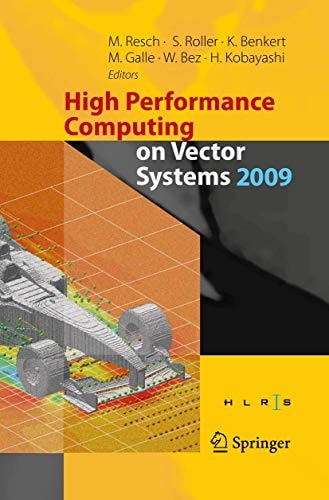
High Performance Computing on Vector Systems 2009
0
0
As an Amazon Associate and affiliate partner, Menrva Books earns from qualifying purchases. Learn more
Author Description
This book covers the results of the Tera op Workbench, other projects related to High Performance Computing, and the usage of HPC installations at HLRS. The Tera op Workbench project is a collaboration between the High Performance C- puting Center Stuttgart (HLRS) and NEC Deutschland GmbH (NEC-HPCE) to s- port users in achieving their research goals using High Performance Computing. The rst stage of the Tera op Workbench project (2004–2008) concentrated on user’s applications and their optimization for the former ag ship of HLRS, a - node NEC SX-8 installation. During this stage, numerous individual codes, dev- oped and maintained by researchers or commercial organizations, have been a- lyzed and optimized. Within the project, several of the codes have shown the ability to outreach the TFlop/s threshold of sustained performance. This created the pos- bility for new science and a deeper understanding of the underlying physics. The second stage of the Tera op Workbench project (2008–2012) focuses on c- rent and future trends of hardware and software developments. We observe a strong tendency to heterogeneous environments on the hardware level, while at the same time, applications become increasingly heterogeneous by including multi-physics or multi-scale effects. The goal of the current studies of the Tera op Workbench is to gain insight in the developments of both components. The overall target is to help scientists to run their application in the most ef cient and most convenient way on the hardware best suited for their purposes.
Menrva's Summary
THE THESIS
This book details advancements and applications in High Performance Computing (HPC) on vector systems, focusing on the outcomes of the Teraflop Workbench project and the utilization of HPC resources at the High Performance Computing Center Stuttgart (HLRS). It explores the collaborative efforts between HLRS and NEC Deutschland GmbH to support researchers in leveraging HPC for their scientific goals. The initial phase concentrated on optimizing user applications for the NEC SX-8 installation, leading to sustained performance exceeding TFlop/s and enabling new scientific discoveries. The current phase investigates hardware and software trends, particularly heterogeneous environments and applications, aiming to facilitate efficient and convenient execution of scientific tasks on suitable hardware.
THE SCOPE MAP
- Results from the Teraflop Workbench project, a collaboration between HLRS and NEC.
- Usage and optimization of High Performance Computing installations at HLRS.
- Analysis and optimization of individual user codes developed by researchers and commercial organizations.
- Demonstration of sustained performance exceeding TFlop/s for specific codes.
- Exploration of current and future trends in hardware and software development for HPC.
- Focus on heterogeneous environments and applications, including multi-physics and multi-scale effects.
- Strategies to help scientists run applications efficiently and conveniently on optimal hardware.
THE AUTHORITY PERSPECTIVE
This collection of research likely presents detailed technical findings and methodologies from ongoing HPC projects. The focus on specific collaborations and hardware installations suggests a readership of researchers, computer scientists, and engineers actively involved in high-performance computing. The depth of analysis into application optimization and hardware trends indicates a text aimed at specialists seeking to advance their understanding and practical application of vector systems in scientific research.
Page Count:
250
Publication Date:
2014-12-13
Publisher:
Springer Berlin Heidelberg
ISBN-10:
3642440940
ISBN-13:
9783642440946
Science
Non-Fiction
Scientific Computing
Computer Science
High Performance Computing
Community Tags
Similar Books