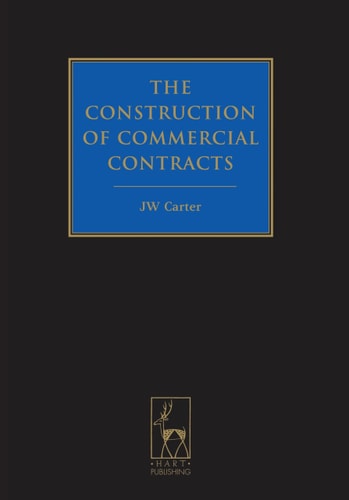
The Construction of Commercial Contracts
0
0
As an Amazon Associate and affiliate partner, Menrva Books earns from qualifying purchases. Learn more
Author Description
This book adopts a principled approach to the law applied in the construction of commercial contracts. This approach is presented as part of a coherent theory of the law of contract construction which makes a unique contribution to scholarship and understanding of the most important aspect of the practice of commercial lawyers. The law is explained by reference to three stages in construction. It distinguishes the preliminary stage in which context is established, from the 'meaning' and 'application' stages of contract construction. The approach provides insights both into the practical problems that lawyers face, in particular in relation to admissibility of extrinsic evidence, and the theoretical underpinnings of the subject. The book also explains the relationship between intention and construction, and discusses general and specific rules that determine the results of construction disputes. Each chapter is introduced by statements of its objectives and the book includes simple definitions of key concepts, as well as summaries of the complex principles which comprise the law of construction. In illustrating construction principles and their application, the exposition of the law draws on the author's knowledge of Australian contract law and the influence and role of the UNIDROIT principles, CISG and the American Restatement (Second) Contracts.
Menrva's Summary
THE THESIS
This book presents a principled and coherent theory for the construction of commercial contracts. The author, JW Carter, a recognized authority in contract law, structures the analysis into three distinct stages: preliminary context establishment, determining the 'meaning' of contract terms, and their 'application'. This framework aims to provide both practical insights for legal practitioners, particularly concerning the admissibility of extrinsic evidence, and a deeper understanding of the theoretical underpinnings of contract interpretation. The work explores the relationship between contractual intention and the process of construction, alongside the rules governing dispute resolution.
THE SCOPE MAP
- A principled approach to the law applied in the construction of commercial contracts.
- A coherent theory of contract construction, distinguishing preliminary, meaning, and application stages.
- Insights into practical legal problems, including the admissibility of extrinsic evidence.
- Discussion on the relationship between intention and construction.
- Explanation of general and specific rules determining the outcomes of construction disputes.
- References to Australian contract law, UNIDROIT principles, CISG, and the American Restatement (Second) Contracts.
- Chapter objectives, simple definitions of key concepts, and summaries of complex principles.
THE AUTHORITY PERSPECTIVE
The book is structured to offer a systematic and theoretical examination of commercial contract construction, distinguishing itself through a principled approach. It aims to bridge practical challenges faced by lawyers with the underlying legal theory, particularly in areas like evidence admissibility. The author's engagement with international legal principles and established restatements suggests a comprehensive and comparative perspective on contract interpretation. The inclusion of chapter objectives and clear definitions indicates a pedagogical intent, making complex principles accessible to students and practitioners alike.
Page Count:
716
Publication Date:
2013-01-04
Publisher:
Bloomsbury UK
ISBN-10:
1782250573
ISBN-13:
9781782250579
Non-Fiction
Commercial law
Contract law
Legal Theory
Law