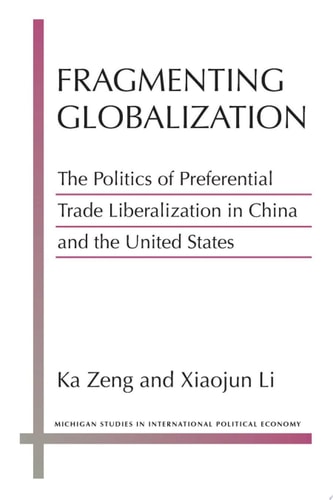
Fragmenting Globalization: The Politics of Preferential Trade Liberalization in China and the United States
0
0
As an Amazon Associate and affiliate partner, Menrva Books earns from qualifying purchases. Learn more
Author Description
Global supply chain integration is not only a rapidly growing feature of international trade, it is responsible for fundamentally changing trade policy at international and domestic levels. Given that final goods are produced with both domestic and foreign suppliers, Ka Zeng and Xiaojun Li argue that global supply chain integration pits firms and industries that are more heavily dependent on foreign supply chains against those that are less dependent on intermediate goods for domestic production. Hence, businesses whose supply chain would be disrupted as a result of increased trade barriers should lobby for preferential trade liberalization to maintain access to those foreign markets. Moreover, businesses whose products are used in the production of goods in foreign countries should also support preferential trade liberalization to compete with suppliers from other parts of the world. Fragmenting Globalization uses multiple methods, including time series, cross-sectional analysis of the pattern of Preferential Trade Alliance formation by existing World Trade Organization members, a firm-level survey, and case studies of the pattern of corporate support for regional trade liberalization in both China and the United States. Zeng and Li show that the growing fragmentation of global production, trade, and investment is altering trade policy away from the traditional divide between export-oriented and import-competing industries.
Menrva's Summary
THE THESIS
This book investigates how global supply chain integration is reshaping trade policy, particularly in China and the United States. The authors argue that this integration creates a new dynamic where firms dependent on foreign supply chains advocate for preferential trade liberalization, while those supplying intermediate goods for foreign production also support such policies. This challenges traditional trade policy divisions based on export-oriented versus import-competing industries. The research examines the formation of Preferential Trade Alliances among WTO members, analyzes firm-level survey data, and presents case studies of corporate support for regional trade liberalization in both China and the US.
THE SCOPE MAP
- Analysis of the pattern of Preferential Trade Alliance formation by existing World Trade Organization members.
- Firm-level survey data on corporate support for trade liberalization.
- Case studies of corporate support for regional trade liberalization in China.
- Case studies of corporate support for regional trade liberalization in the United States.
- Examination of how global supply chain integration alters traditional trade policy divides.
THE AUTHORITY PERSPECTIVE
This book offers a detailed analysis of the evolving landscape of international trade policy, focusing on the impact of global supply chain integration. It presents a novel framework for understanding how businesses with differing dependencies on international production networks advocate for preferential trade liberalization. The research methodology, combining quantitative analysis of trade alliances with qualitative case studies, provides a robust examination of these dynamics in China and the United States.
Page Count:
320
Publication Date:
2021-03-15
Publisher:
University of Michigan Press
ISBN-10:
047212837X
ISBN-13:
9780472128372
Non-Fiction
Economics
Politics
Trade Policy
International relations
Globalization
Community Tags
Similar Books