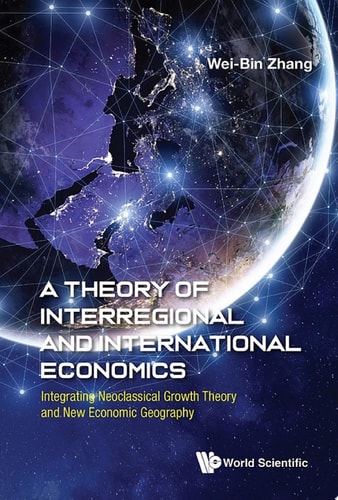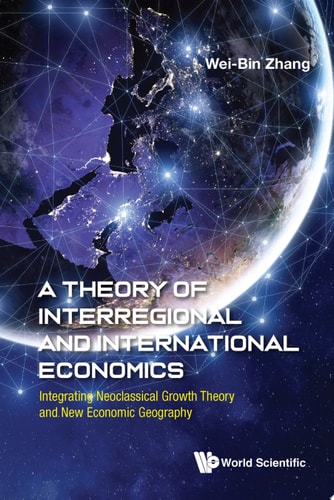
Theory of Interregional and International Economics, A: Integrating Neoclassical Growth Theory and New Economic Geography
0
0
As an Amazon Associate and affiliate partner, Menrva Books earns from qualifying purchases. Learn more
Author Description
The contemporary global economy is characterized by complex and nonlinear dynamics of interregional and international economic interactions. The complexity is associated with endogenous changes in wealth, human capital, technology, population, economic structures and gender relations. It is obviously necessary to construct a theory to connect all these changes in a single analytical framework with minimum assumptions. Nevertheless mainstream economic theory on spatial economics is mostly static and partial. This book expands on spatial economics by integrating various theories of spatial economics into a comprehensive and analytical framework through mathematical modelling and computing.This book is part of the author's general economic theory with endogenous population, capital, knowledge, preferences, sexual division of labor and consumption, institutions, economic structures, and exchange values over time and space. It focuses on further developing the theory of interregional and international economies and encompasses dynamic relations between population growth, human capital and wealth accumulation, environmental change, gender, institutions, market structures, the division of labor and consumption, and the determination of price structure among regions and nations in a single analytical framework.
Menrva's Summary
THE THESIS
This book constructs a comprehensive analytical framework to model the complex, nonlinear dynamics of interregional and international economic interactions. It integrates neoclassical growth theory with new economic geography, addressing endogenous changes in wealth, human capital, technology, population, economic structures, and gender relations. The author utilizes mathematical modeling and computing to expand on existing spatial economics, which is often static and partial. This work aims to connect these dynamic elements within a single framework with minimal assumptions, building upon the author's broader economic theory.
THE SCOPE MAP
- Integration of Neoclassical Growth Theory and New Economic Geography
- Mathematical modeling and computing for spatial economics
- Analysis of endogenous changes in wealth, human capital, technology, and population
- Inclusion of economic structures and gender relations in economic models
- Development of a comprehensive and analytical framework for interregional and international economies
- Dynamic relations between population growth, human capital, and wealth accumulation
- Consideration of environmental change, institutions, and market structures
- Determination of price structure among regions and nations within a single framework
THE AUTHORITY PERSPECTIVE
The book presents a sophisticated theoretical model for understanding contemporary global economic dynamics, aiming to bridge gaps in existing spatial economics literature. Its comprehensive approach integrates multiple factors such as population, human capital, and gender relations into a unified analytical framework. The use of mathematical modeling suggests a rigorous and data-driven exploration of interregional and international economic interactions. This work is positioned as a significant contribution to economic theory by offering a holistic perspective on complex global economic phenomena.
Page Count:
404
Publication Date:
2024-12-01
Publisher:
World Scientific
ISBN-10:
9811294879
ISBN-13:
9789811294877
Non-Fiction
Science & Technology
Economics
Economic Growth
Mathematical Economics
Economic Theory
Community Tags
Similar Books