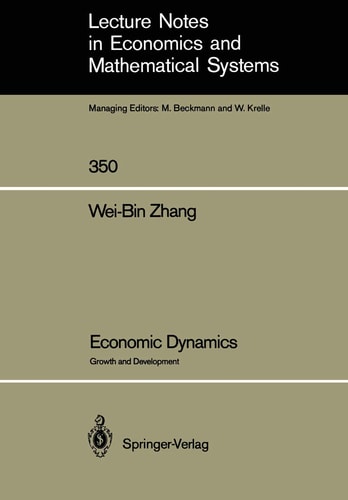
Economic Dynamics: Growth and Development
0
0
As an Amazon Associate and affiliate partner, Menrva Books earns from qualifying purchases. Learn more
Author Description
The theory of economic development is a branch of economic dynamics. Any discussion of the theory must involve dynamics even though not all dynamic problems are necessarily related to economic development. The theory's primary locus is upon the nice paths of economic variables. Stationary states, which have been the main concern of modem economic development theory, are actually special cases of economic dynamics. In this study, we propose an economic development theory within the framework of input-output systems and neoclassical economics. No political problems will be dealt with, although this does not mean that questions such as why Japan had a higher growth rate than China in the past are not important. Similarly, rather than dealing with the psychological and institutional aspects of in economic development processes we only suggest ways (or methods, as Hicks would call them) for analyzing what determines economic development from the point of view of "pure" economics. Our main contribution to economic growth theory is that we investigate various nonlinear dynamic phenomena such as bifurcations and economic cycles. We emphasize that oscillations and structural changes are not rare but universal in a progressive economy. No economic system can be stabilized forever if change is permitted.
Menrva's Summary
THE THESIS
This book proposes a new theory of economic development grounded in input-output systems and neoclassical economics, focusing on dynamic phenomena rather than static states. The author, Wei-Bin Zhang, investigates nonlinear dynamic phenomena such as bifurcations and economic cycles, emphasizing that oscillations and structural changes are universal in a progressive economy. The study aims to analyze the determinants of economic development from a
THE SCOPE MAP
- Analysis of economic development within input-output systems and neoclassical economics.
- Investigation of nonlinear dynamic phenomena including bifurcations and economic cycles.
- Emphasis on oscillations and structural changes as universal features of progressive economies.
- Methodology for analyzing economic development determinants from a "pure" economics perspective.
THE AUTHORITY PERSPECTIVE
The book is presented as a theoretical exploration within economic dynamics, focusing on mathematical and neoclassical frameworks. It aims to contribute to economic growth theory by examining nonlinear dynamics. The approach eschews political and psychological aspects of development in favor of a rigorous economic analysis.
Page Count:
232
Publication Date:
1990-11-01
Publisher:
Springer Verlag
ISBN-10:
038753217X
ISBN-13:
9780387532172
Non-Fiction
Economics
Science & Technology
Economic Growth
Economic Theory
Mathematical Economics
Community Tags
Similar Books