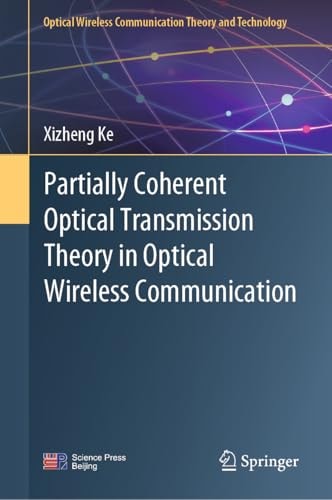
Partially Coherent Optical Transmission Theory in Optical Wireless Communication
0
0
As an Amazon Associate and affiliate partner, Menrva Books earns from qualifying purchases. Learn more
Author Description
This book introduces the theory and research methods of partially coherent optical, points out the significance of this study, analyzes the basic theories involved in partially coherent light, and explains the complete coherence of laser is not a necessary condition for good directivity, and partially spatially coherent optical sources can also produce the same far-field intensity distribution as lasers. This type of beam with good directivity but only partial spatial coherence is called a Gaussian Schell model beam, which can be used as a physical model to describe multimode lasers under certain conditions. This book is applicable to the large number of engineers and technicians involved in wireless optical communication and college teachers. It can also be used as a teaching material for graduate students and senior undergraduates in related fields.
Menrva's Summary
THE THESIS
This book investigates the theoretical underpinnings and research methodologies of partially coherent optical transmission within the context of optical wireless communication. It highlights the importance of this field, delves into the fundamental theories governing partially coherent light, and demonstrates that perfect coherence is not a prerequisite for excellent directivity in optical beams. The text establishes that beams with strong directivity but only partial spatial coherence, such as Gaussian Schell model beams, can achieve the same far-field intensity distribution as lasers, serving as a model for multimode lasers under specific conditions.
THE SCOPE MAP
- Introduction to the theory and research methods of partially coherent optical transmission.
- Analysis of the significance and basic theories of partially coherent light.
- Explanation of how partially spatially coherent optical sources can achieve laser-like directivity.
- Detailed discussion of the Gaussian Schell model beam as a physical model.
- Application of these theories to wireless optical communication.
- Target audience includes engineers, technicians, and graduate/undergraduate students in related fields.
THE AUTHORITY PERSPECTIVE
The book is positioned as a technical resource for professionals and students in optical wireless communication. Its focus on the theoretical aspects of partially coherent light suggests it aims to provide a foundational understanding for advanced research and practical application. The content appears to bridge theoretical optics with the specific demands of modern communication systems, indicating a potential for detailed analysis and rigorous exposition.
Page Count:
306
Publication Date:
2024-11-04
Publisher:
Springer Nature Singapore
ISBN-10:
9819771579
ISBN-13:
9789819771578
Science & Technology
Science
Non-Fiction
Engineering
Wireless Communication
Optics