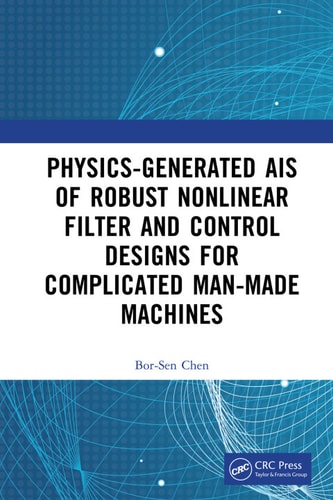
Physics-Generated AIs of Robust Nonlinear Filter and Control Designs for Complicated Man-Made Machines
0
0
As an Amazon Associate and affiliate partner, Menrva Books earns from qualifying purchases. Learn more
Author Description
This book introduces a robust H∞ physics-generated AI-driven filter and controller, along with a nonlinear Luenberger observer model and a state estimation error dynamic model, to effectively address HJIEs for robust H∞ state estimation (filtering) and reference trajectory tracking control in nonlinear stochastic systems. Additionally, it presents a method for training deep neural networks (DNNs) using these models, alongside a physics-generated AI-driven observer-based reference tracking control scheme, with applications in the guidance and control of relevant systems. Key features: Provides theoretical analysis and detailed design procedure for physics-generated AI-driven H∞ or mixed H2/H∞ filter Applies physics-generated AI-driven robust H∞ or mixed H2/H∞ filter and reference tracking control schemes to the trajectory estimation and reference tracking control of man-made machines Introduces physics-generated AI-driven decentralized H∞ observer-based team formation tracking control of large-scale quadrotor UAVs, biped robots or LEO satellites Promulgates the idea of the forthcoming age of physics-generated AI in robot Describes robust physics-generated AI-driven filter and control schemes for complex man-made machines This book is aimed at graduate students and researchers in control science, signal processing and artificial intelligence.
Menrva's Summary
THE THESIS
This book introduces a novel approach to designing robust filters and controllers for complex nonlinear systems using physics-generated artificial intelligence. The author, Bor-Sen Chen, presents a framework that integrates a robust H∞ physics-generated AI-driven filter and controller with a nonlinear Luenberger observer model and a state estimation error dynamic model. This methodology is designed to effectively address Hamilton-Jacobi-Isaacs equations (HJIEs) for robust H∞ state estimation and reference trajectory tracking control in nonlinear stochastic systems. The work also details a method for training deep neural networks (DNNs) using these models, culminating in an observer-based reference tracking control scheme with applications in guidance and control systems.
THE SCOPE MAP
- Provides theoretical analysis and detailed design procedures for physics-generated AI-driven H∞ or mixed H2/H∞ filters.
- Applies physics-generated AI-driven robust H∞ or mixed H2/H∞ filter and reference tracking control schemes to trajectory estimation and reference tracking control of man-made machines.
- Introduces physics-generated AI-driven decentralized H∞ observer-based team formation tracking control for large-scale systems like quadrotor UAVs, biped robots, or LEO satellites.
- Promulgates the concept of the forthcoming era of physics-generated AI in robotics.
- Describes robust physics-generated AI-driven filter and control schemes tailored for complex man-made machines.
THE AUTHORITY PERSPECTIVE
This book is aimed at graduate students and researchers in control science, signal processing, and artificial intelligence, suggesting a specialized and advanced readership. The detailed design procedures and theoretical analyses indicate a focus on rigorous academic and engineering applications. The inclusion of specific examples such as quadrotor UAVs and biped robots points to practical relevance within advanced robotics and control engineering fields. The book's premise of physics-generated AI suggests it contributes to the ongoing development and integration of AI within physical systems.
Page Count:
0
Publication Date:
2026-03-18
Publisher:
Taylor & Francis
ISBN-10:
1040748651
ISBN-13:
9781040748657
Non-Fiction
Science & Technology
Science
Engineering
Robotics
Control systems
Community Tags
Similar Books